- Call us 01444 237070

-
- Back
- Used Cameras
- Used Accessories
- Used Lenses
- Back
- Used Canon Lenses
- Used Nikon Lenses
- Used Fujifilm Lenses
- Used Sony Lenses
- Used Micro 4/3rds Lenses
- Used Leica Lenses
- Used Panasonic Lenses
- Used Pentax Lenses
- Used Samyang Lenses
- Used Sigma Lenses
- Used Tamron Lenses
- Used Tokina Lenses
- Used Voigtlander Lenses
- Used Zeiss Lenses
- Used Hasselblad Lenses
- Used Video
- Used Film Equipment
- Used Stock Alert
- Used Blank Test
- Sell or Part Exchange
- Used Clearance
- Recently Added Used Equipment
- Park Picks
- Faulty
- Trade-In
- Blog
- New in
- Call us
- Contact us
- Stores
- Sign in
- Categories
- Tips & Inspiration
- Reviews
- News
- Events
- Features
- Buying Guides
- Competitions
Is the Nikon Z MC 50mm f/2.8 Macro Worth It
As part of Used Week, we’ve tried and tested four used Nikon products, with this hands-on review focusing on whether the Nikon Z MC 50mm f/2.8 Macro is worthy of your hard-earned cash. This compact Nikon 50mm lens was released not long after the original Z5 camera, which was used for all of the included sample images.
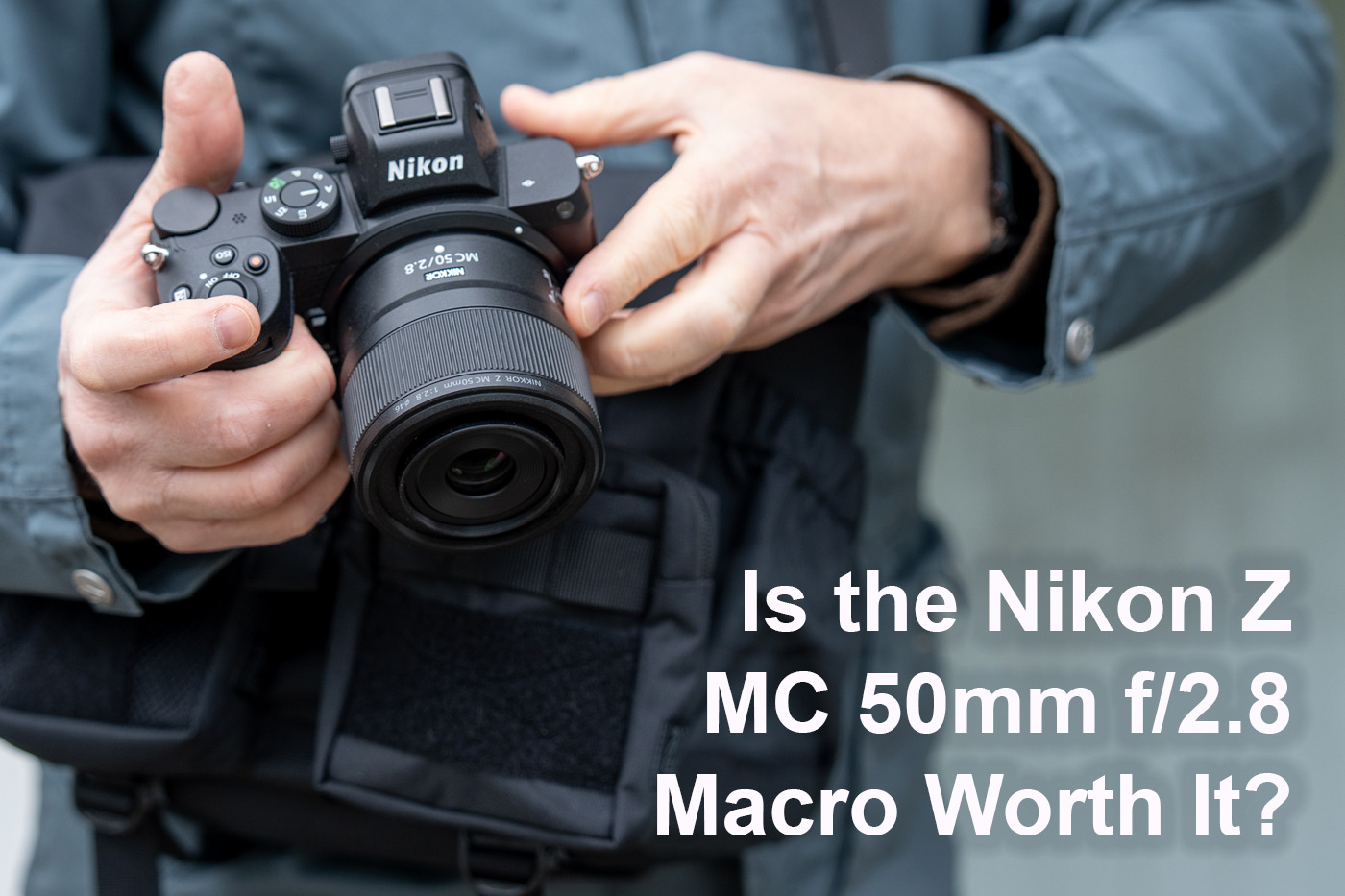
The Z-mount has plenty of choice when it comes to 50mm lenses, so why would you choose the Nikon Z MC 50mm Macro over any of the others? For starters, it’s a general-purpose standard prime lens, which is always useful, but it also captures 1:1 macro shots, extending its versatility considerably.
It’s also small and lightweight, which is ideal when out and about capturing everyday content, so why not join us to discover whether the Nikon 50mm Z macro might be the perfect standard lens you’ve been waiting for.

Sample 01 Nikon Z MC 50mm f/2.8 Macro Closeup window with Nikon Z5. Camera settings: 1/200 sec. f/3. ISO 1250 (right click to open larger)
Where does this lens fit into the Nikon Z mount range?
As touched on, the Nikon Z-mount has several 50mm options from Nikon (NIKKOR). With that in mind, we’ve created the comparison table below, which highlights the differences and similarities between these four 50mm prime lenses, which are all for full-frame Nikon mirrorless cameras.
|
|
||||
|
Release year |
2021 |
2025 |
2020 |
2018 |
|
RRP |
£619.00 |
£499.00 |
£2,299.00 |
£569.00 |
|
Typical used price |
£414.00 |
£380.00 |
£1,459.00 |
£389.00 |
|
Format |
FX (full-frame) |
FX (full-frame) |
FX (full-frame) |
FX (full-frame) |
|
Maximum aperture |
f/2.8 |
f/1.4 |
f/1.2 |
f/1.8 |
|
Minimum aperture |
f/22 |
f/16 |
f/16 |
f/16 |
|
Lens construction |
10 elements in 7 groups |
10 elements in 7 groups |
17 elements in 15 groups |
12 elements in 9 groups |
|
Special elements |
1 ED glass element, 1 aspherical lens element |
1 aspherical lens element |
2 ED glass and 3 aspherical lens elements |
2 ED glass and 2 asphericasl lens elements |
|
Angle of view |
FX format: 47° |
FX format: 47° |
FX format: 47° |
FX format: 47° |
|
Minimum focus distance |
0.16 m |
0.37 m |
0.45 m |
0.4 m |
|
Maximum reproduction ratio |
1:1 |
0.17x |
0.15x |
0.15x |
|
Diaphragm blades |
9 (rounded) |
9 (rounded) |
9 (rounded) |
9 (rounded) |
|
Filter-attachment size |
46 mm |
62 mm |
82 mm |
62 mm |
|
Weather sealing |
Dust- and drip-resistant |
N/A |
Superior dust- and drip-resistant |
Dust- and drip-resistant |
|
AF system |
STM |
STM |
Dual STM |
STM |
|
Coatings |
multicoating |
N/A |
Nano Crystal & ARNEO |
Nano Crystal / ARNEO |
|
Dimensions |
74.5 x 66 mm |
74.5 x 86.5 mm |
89.5 x 150 mm |
76 x 86.5 mm |
|
Weight |
260 g |
420 g |
1,090 g |
415 g |
|
Notes / Special features |
1:1 macro reproduction, compact and lightweight |
Lightweight no frills “nifty fifty” |
Premium S-Line, with ultra shallow DOF |
Classic prime with S-Line optics |

Sample 02 Nikon Z MC 50mm f/2.8 Macro Gnomes with Nikon Z5. Camera settings: 1/125 sec. f/2.8. ISO 900 (right click to open larger)
Although this isn’t intended as a comparison review, from the specs we can say that Z MC 50mm f/2.8 Macro is the smallest and lightest. As well as this, it’s the only one capable of 1:1 magnification, which makes it arguably more versatile, despite the slower aperture.
At the other end of the scale, the Z 50mm f/1.2 S is all about capturing a shallow depth of field with high optical performance, but at the cost of a much larger, heavier design. Both the Z 50mm f/1.8 S and Z 50mm f/1.4 lie in the middle, with faster apertures than the macro, while coming nowhere near the size and cost of the f/1.2 lens.

100% crop showing sharpness at f/2.8 wide open from the previous image
Is it ok to buy a second-hand lens?
The comparison table above shows how used camera lenses can cost quite a lot less than brand-new equivalents. The concern for many is buying a lens without knowing its history, which is where purchasing from a trusted retailer such as Park Cameras can make a difference.
All used equipment is checked and assessed by trained staff prior to being listed for sale, and each lens is graded based on condition and wear, with listings noting what’s included, such as a lens hood or case.
Buying from a specialist retailer also means you’ll get a warranty, which adds reassurance compared to buying from private marketplaces, where condition and after-sales support can be unpredictable. While testing this lens for used week, I also got hands-on to find out is the Nikon Z 24-200mm VR Lens right for you, which is another excellent second-hand option.

Sample 03 Nikon Z MC 50mm f/2.8 Macro Portrait with Nikon Z5. Camera settings: 1/200 sec. f/3. ISO 140 (right click to open larger)
Nikon Z MC 50mm f/2.8 Macro sample images
To capture a variety of Z MC 50mm f/2.8 Macro lens sample images, Nick Dautlich used a combination of Manual, Shutter Priority, and Aperture Priority modes with the Nikon Z5 camera, which we covered in our guide: Is the Original Nikon Z5 Worth Buying?
Shooting conditions ranged from light rain and overcast skies to brighter sunlight. The photo samples span near to far subjects, and are edited mildly using contrast, tone curves, vibrance, and other minor adjustments, giving you the chance to see how this combination of camera and lens performs.

Sample 04 Nikon Z MC 50mm f/2.8 Macro Trees (fringing test) with Nikon Z5. Camera settings: 1/100 sec. f/2.8. ISO 400 (right click to open larger)
What is a 50mm lens good for?
The merits of 50mm lenses have been discussed for decades, with photographers of all skill levels and specialisms favouring this classic focal length for image-making. The popularity revolves around this ‘standard’ lens being able to capture subjects with a natural perspective and low distortion that is similar to human vision.
This allows the photographer to capture a huge variety of everyday subjects such as:
- Portraits / family photos
- Weddings / events
- Reportage / street photography
- Landscapes / cityscapes
- Food / products
- Snapshots / everyday creativity

100% crop showing well controlled fringing from previous image
This only scratches the surface of what you can do at this focal length, which is extremely versatile for everyday storytelling. Adding macro abilities like the Nikon lens does add another layer if you ever want to capture frame-filling close-ups, as most 50mm lenses aren’t generally able to focus particularly close.
However, you should be aware that at minimum focus distances a 50mm lens can easily cast a shadow over your subject. This is why many dedicated macro lenses use a longer focal length to create more working distance, such as the one discussed in our Nikon Z MC 105mm f/2.8 VR S Macro Lens Review, which may be a better fit if close-ups are your main goal.
So let’s look at image quality next, as that is an important factor for many creators.
How good is the 50mm f/2.8 Z MC Macro image quality?
Having no preconceptions about image quality, I was excited to see what this little prime lens could do. After just a short while, it was obvious it can handle just about anything you might want, from soft, dreamy defocus to razor-sharp detail in the subject.
It is extremely sharp at portrait distances (of around 2m) even when wide open at f/2.8, and excellent at close distances. I carried out a couple of more deliberate tests to look for optical weaknesses such as colour fringing (chromatic aberration), where high-contrast edges can show undesirable coloured outlines.
The lens performed very well, exhibiting virtually no colour fringing at all, along with accurate colour and detailed rendering. It’s an impressive optic for the size and price, especially if you enjoy high levels of sharpness combined with soft, out-of-focus backgrounds.
It certainly ticks all the boxes for the intended use as a general purpose standard prime, which you can also capture close-ups with, but how is build quality and handling?

Sample 05 Nikon Z MC 50mm f/2.8 Macro Bokeh with Nikon Z5. Camera settings: 1/250 sec. f/3. ISO 3200 (right click to open larger)
Build quality and handling
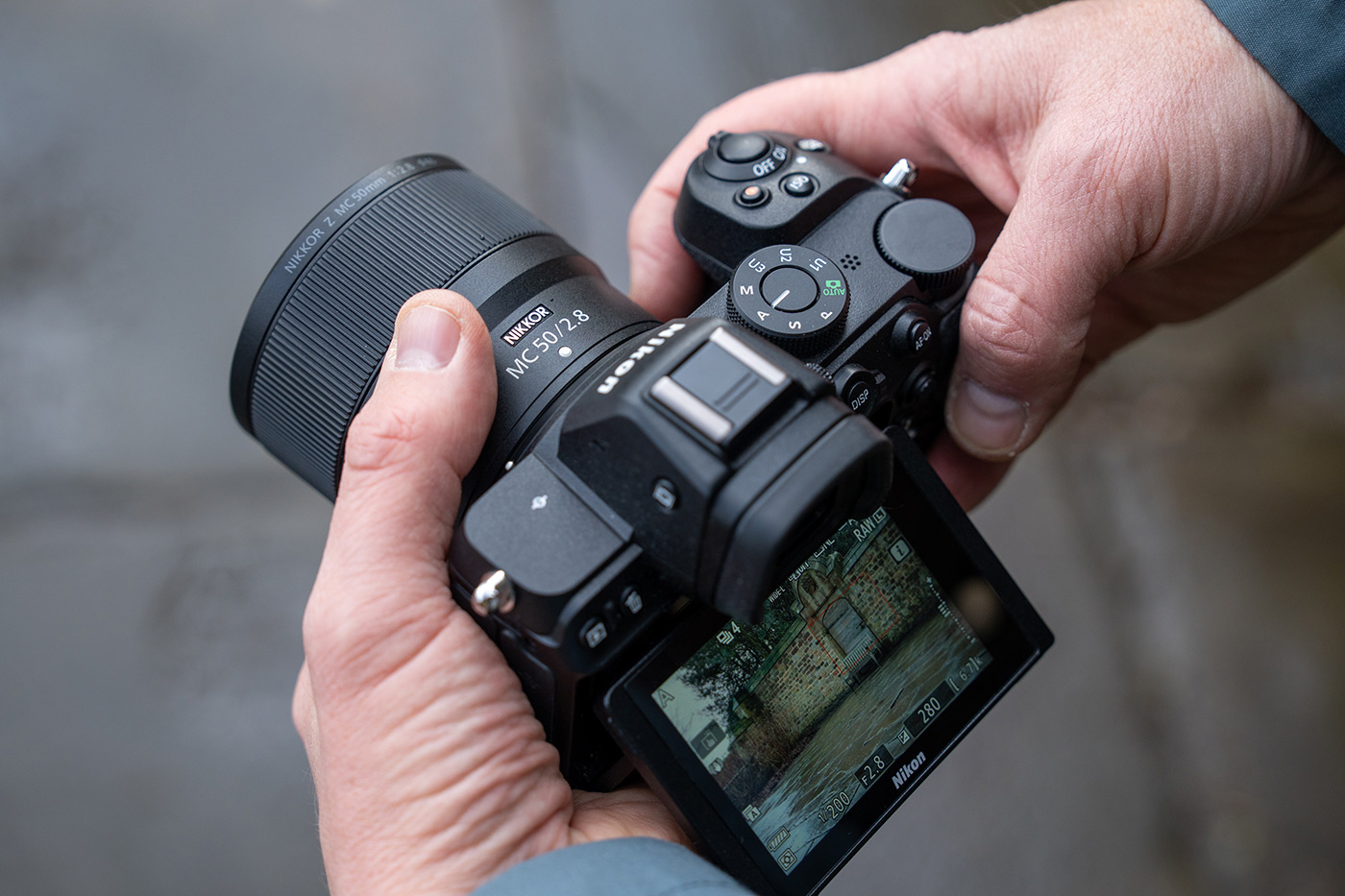
Nikon has used quite plasticky materials for this model, which feel solid enough but aren’t particularly premium compared to many other Z-mount lenses. Controls are sparse too, with just a single programmable control ring, set to focus by default, along with an AF/MF switch.
In practice, this makes for an easy lens to work with, as there’s very little to interfere with the process of making images, and it’s very lightweight for handholding. The focus ring works smoothly enough when you need it, and autofocus driven by the STM is perfectly reasonable. It’s certainly quicker than most dedicated macro lenses, although not as fast as premium options like the dual focus system used in the Z 50mm F/1.2 S.
It was only at very close distances where manual focus became essential, with the Z5 and lens combination sometimes struggling to decide what to focus on. At portrait and longer distances, it had no such issues and delivered very good results throughout.
Nikon has provided comprehensive weather sealing, which is ideal for outdoor use, and it has a very compact 46mm filter thread, enabling the use of cost effective lens filters as required.

Sample 06 Nikon Z MC 50mm f/2.8 Macro Closeup flowers with Nikon Z5. Camera settings: 1/200 sec. f/4.2. ISO 200 (right click to open larger)
Does the Nikon Z MC 50mm f/2.8 Macro lens have internal focusing?
No, unfortunately the barrel extends as you focus. While this is quite common for macro lenses, it results in a very short working distance of around 5 cm at maximum extension. In practice, this can easily cast shadows over your subject and may also disturb living subjects such as butterflies and insects.
It also means you need to take a bit more care at very close distances to avoid accidentally knocking the barrel when fully extended. These are typical downsides in this class, but good to know.

Sample 07 Nikon Z MC 50mm f/2.8 Macro Plants with Nikon Z5. Camera settings: 1/200 sec. f/2.8. ISO 720 (right click to open larger)
Is the Z MC 50mm f/2.8 Macro good for portraits?
Yes, this is a great choice for portraits, especially for more candid and naturally lit shots. The combination of sharpness, soft background blur from the wide f/2.8 aperture, and faithful colours help create natural, well-balanced portraits of people and pets.
Is it a good choice for beginners?
Yes. With simple controls, extremely portable handling, and competent focusing, this is a good choice for beginners through to intermediate and professional users. While you do need to be aware of the extending lens barrel, it’s an easy lens to shoot with and captures very good results.
Of course, like any subject, macro takes practice, so expect to get out and use it in order to improve your close-up skills.
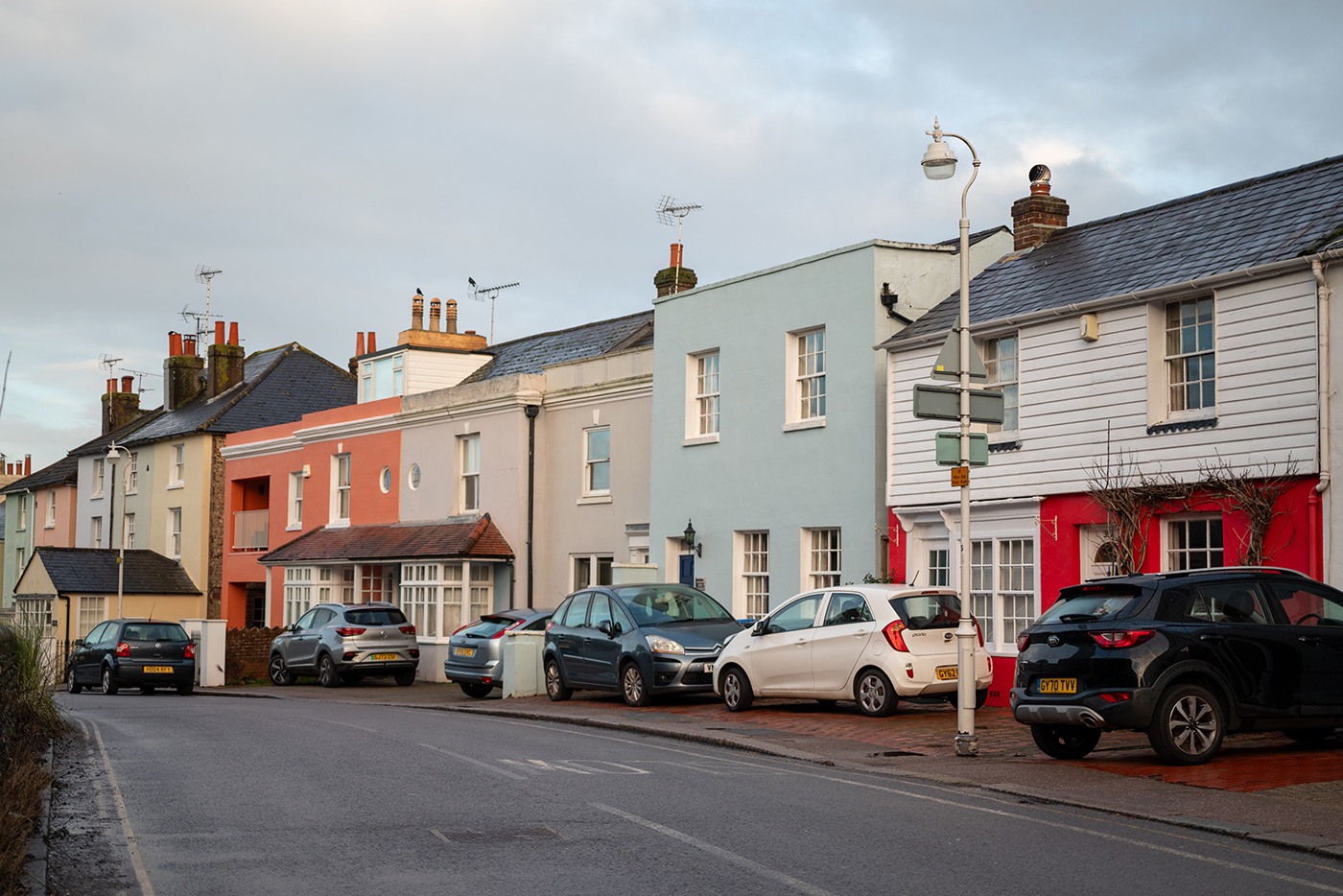
Sample 08 Nikon Z MC 50mm f/2.8 Macro Street with Nikon Z5. Camera settings: 1/200 sec. f/3.5. ISO 110 (right click to open larger)
Who should get this lens?
The Z MC 50mm f/2.8 Macro has plenty going for it to tempt anyone looking for a 50mm lens.
While there are other options that capture more pronounced subject separation, the Z MC 50mm f/2.8 Macro is well suited to everyday photography, natural portraits, and general use, while also giving you the option to get very close to subjects for macro shooting.
It’s especially appealing for those who want the most lightweight kit possible, and it delivers excellent sharpness from near to far distances. I think it’s safe to say, that for the right photographer, this Nikon macro lens is most definitely worth it, especially considering second-hand prices.
Reserve your brand new Z MC 50mm f/2.8 Macro today, or browse used Nikon lenses to not only save, but also discover new and exciting focal lengths to suit your style of creativity.
Share this post:
By Nick Dautlich on 12/02/2026

Nick Dautlich
Senior Content Writer and Product Reviewer
Nick Dautlich is the Senior Content Writer and Product Reviewer at Park Cameras, with over 15 years of photography experience. A Sony Imaging Professional and expert reviewer, Nick has worked with major brands such as Canon, Sony and Nikon. His work is also featured on Vanguard World UK’s website, Capture Landscapes, and Shutter Evolve. Nick’s photography includes National Trust projects and magazine covers and he is passionate about landscapes and storytelling. Nick also enjoys hiking and teaching his children about nature. Learn more on his profile page.
Trade in your old equipment
Fast and easy trade in service ensures your old gear is collected efficiently and you are paid quickly! It's very simple to trade in your unwanted photography gear. Just head over to our dedicated Sell or Part Exchange page, fill out the details, and we'll get back to you with an offer for your old gear. Take the cash, or put it towards the cost of your new gear. It's up to you! Find out more
sign up to the newsletter
Keep up to date on the latest photography news, events and offers. Sign up now