- Call us 01444 237070

-
- Back
- Used Cameras
- Used Accessories
- Used Lenses
- Back
- Used Canon Lenses
- Used Nikon Lenses
- Used Fujifilm Lenses
- Used Sony Lenses
- Used Micro 4/3rds Lenses
- Used Leica Lenses
- Used Panasonic Lenses
- Used Pentax Lenses
- Used Samyang Lenses
- Used Sigma Lenses
- Used Tamron Lenses
- Used Tokina Lenses
- Used Voigtlander Lenses
- Used Zeiss Lenses
- Used Hasselblad Lenses
- Used Video
- Used Film Equipment
- Used Stock Alert
- Used Blank Test
- Sell or Part Exchange
- Used Clearance
- Recently Added Used Equipment
- Park Picks
- Faulty
- Trade-In
- Blog
- New in
- Call us
- Contact us
- Stores
- Sign in
- Categories
- Tips & Inspiration
- Reviews
- News
- Events
- Features
- Buying Guides
- Competitions
Canon EOS R6 V Review
Following on from the EOS R50 V, which launched in March 2025, the Canon EOS R6 V is the second dedicated V-for-Video model to join Canon's mirrorless camera lineup.
Gareth's hands-on video review of the EOS R6 V
In our Canon EOS R6 V review, you'll discover where the latest model sits in the range by comparing it with the R6 Mark III and EOS C50. We also explore the impressive video feature set that this compact creator camera offers, which includes Open Gate, internal 7K 60p RAW recording, and an updated video-first body design.
Gareth shares his thoughts in the hands-on video review above, highlighting some of the key features that solo creators can expect to benefit from. We also provide a variety of sample images to help you decide whether this is the best Canon hybrid camera for your needs.
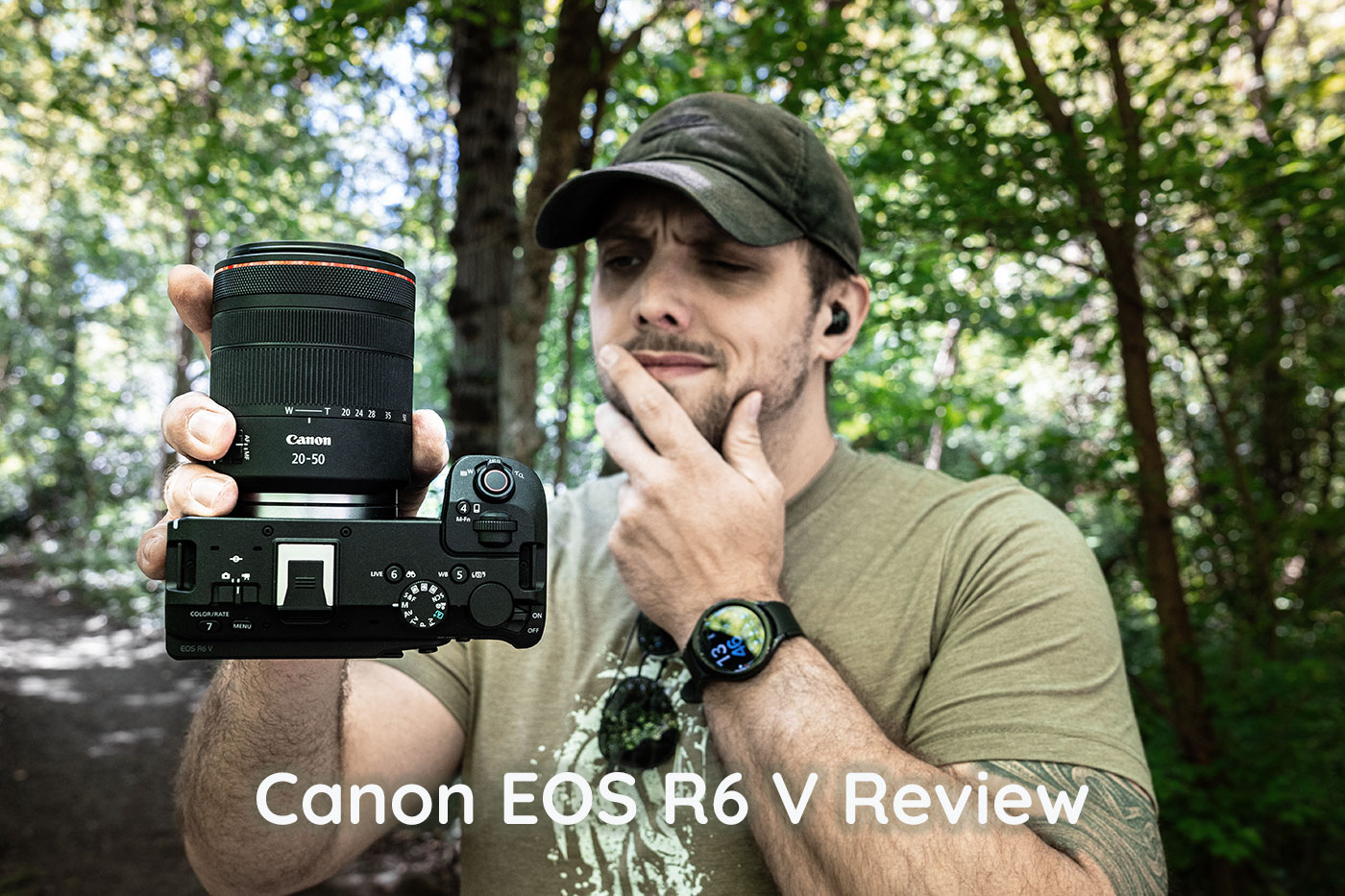
So whether you're here for the specs comparison, real-world applications, or just interested in what might be one of the best Canon video cameras for 2026, join us as we start off by looking at the launch date and UK price.
Canon EOS R6 V Price and Launch Details
With a release on 13th May 2026, the Canon EOS R6 V arrives with a body-only price of £2,399.00, and £3,549.99 for the EOS R6 V with RF 20-50mm PZ Lens Kit. The RF 20-50mm F4 L IS USM PZ lens also joins the launch, priced at £1,439.99.
Despite offering comparable features, we're pleased to see it priced slightly lower than the R6 Mark III, which carries an RRP of £2,799.00.
Next, let's remind ourselves what the V in the naming convention stands for.
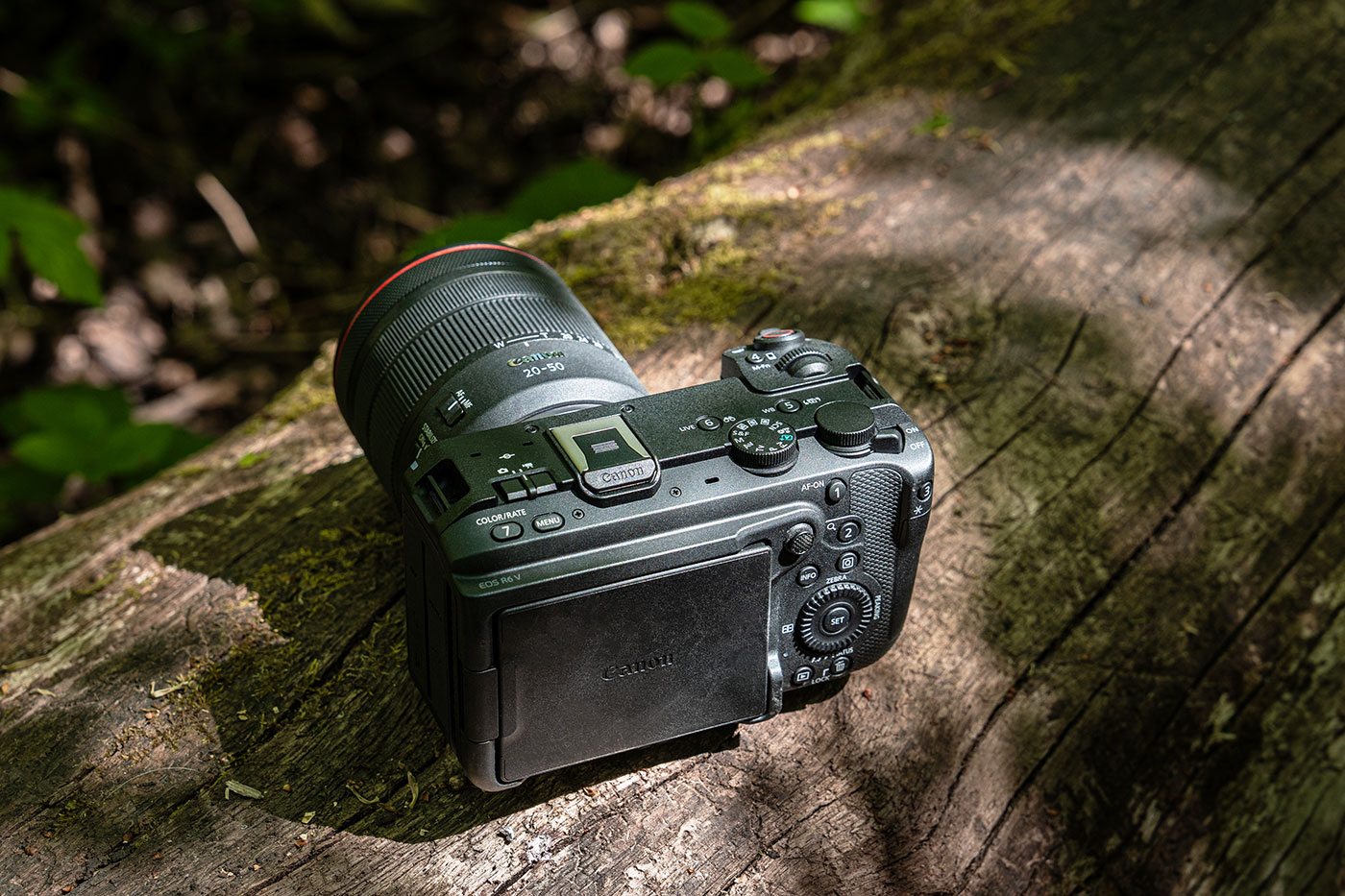
What are Canon V-Series mirrorless cameras?
As touched on, this is the second V-series Canon video camera to arrive in a range of dedicated video-first interchangeable lens cameras aimed at content creators, vloggers, and streamers. The existing EOS R50 V is smaller and more beginner-orientated, whereas the R6 V features an updated body design and more advanced feature set.
With that in mind, next we discover what it brings to the party.
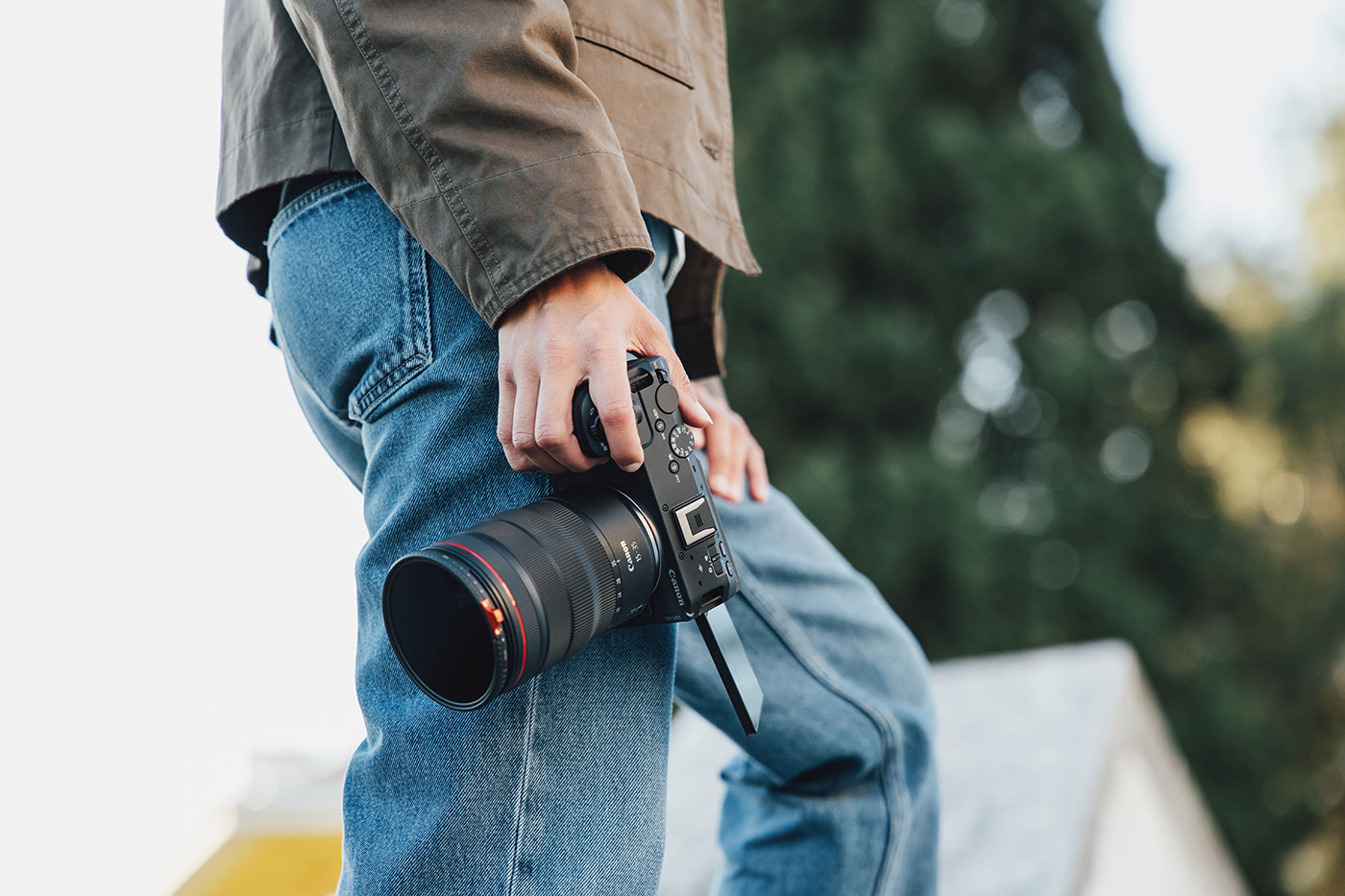
R6 V Key features
With a refined video-first body and a full-frame sensor, this interchangeable lens Canon mirrorless camera is set to deliver cinematic quality to filmmakers and content creators looking to build a personal brand and level up their range of video services.
It does this through an extensive list of features, including:
- 7K/60p open gate recording (click here to learn more about open gate)
- Up to 7.5-stops in-body image stabilisation
- A video-first body design and new button layout
- Active cooling system for long-form content
- Wired and wireless streaming
- Native support for vertical content
Canon is covering all bases with this design, combining some of the best features from their mirrorless range with video capabilities drawn from the cinema line.
But is it just a scaled-down cinema camera? Let's find out next.
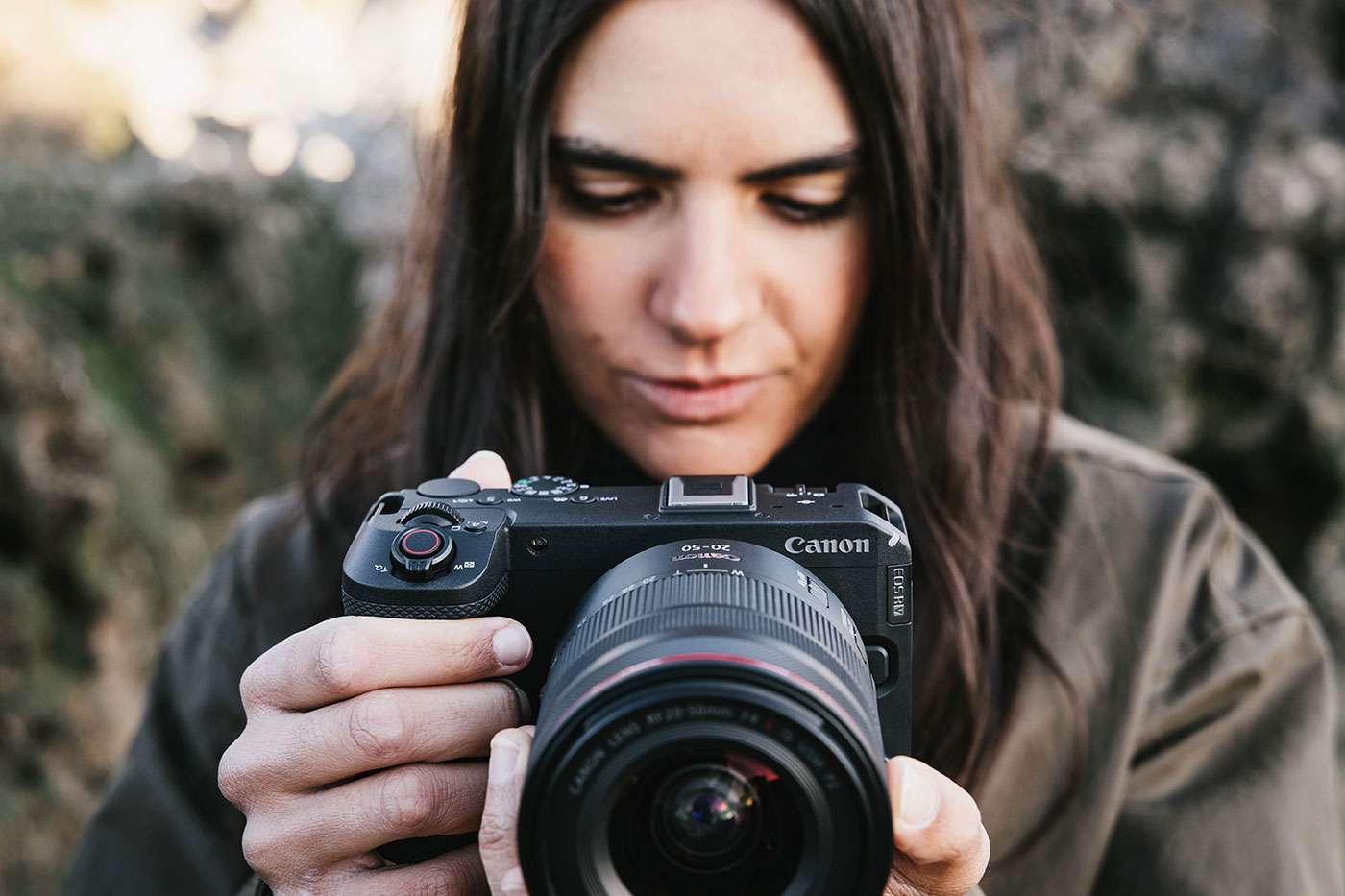
Is the EOS R6 V a mini Cinema EOS camera?
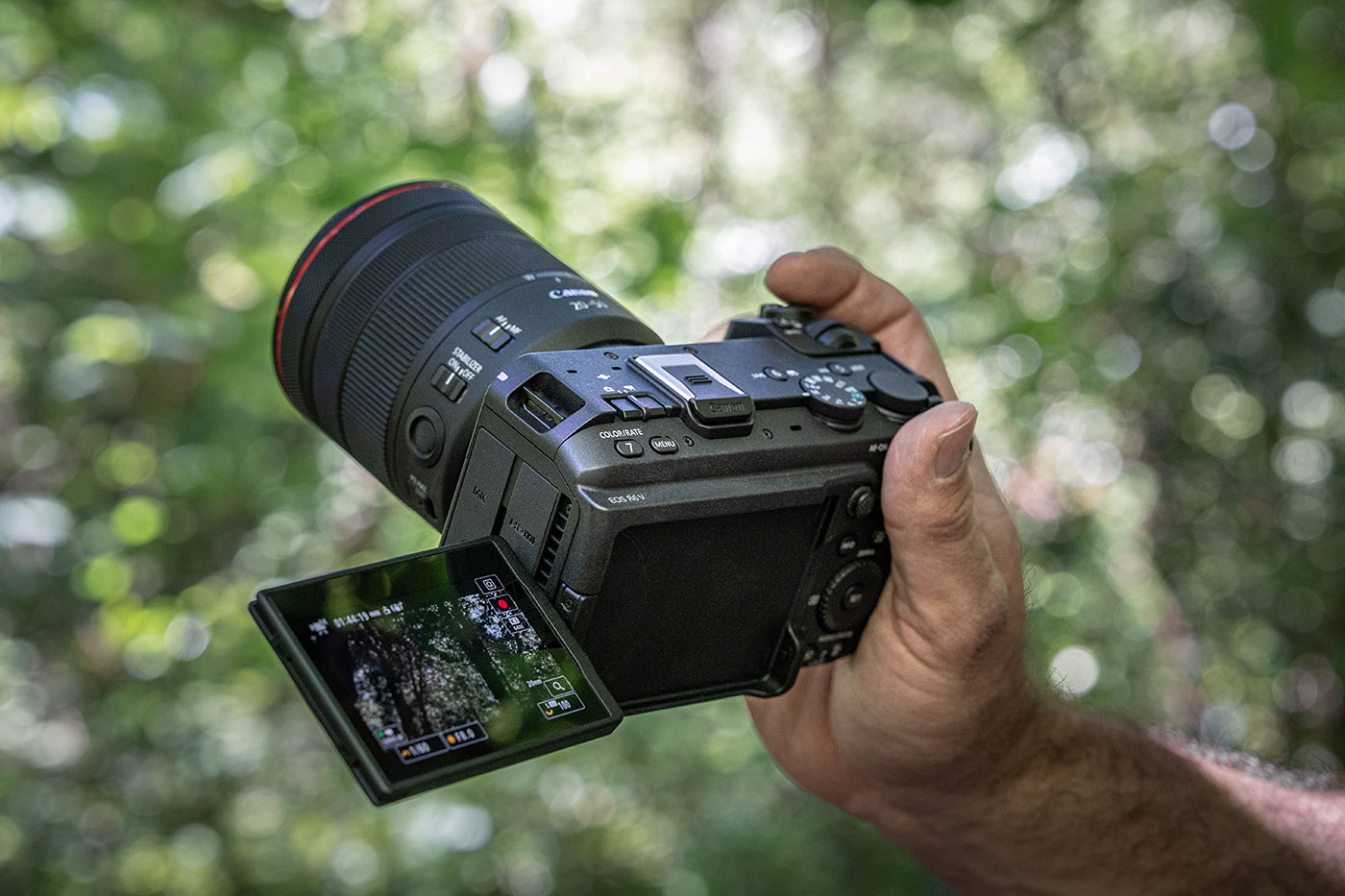
With a boxier appearance and notable video-first controls, the Canon EOS R6 V definitely bridges the gap between Canon's mirrorless and moviemaking ranges. The body design includes:
- A vertical tripod mount with automatic vertical UI
- Front and top record buttons
- Zoom lever for PZ (power zoom) lenses
- A deeper grip for handheld shooting, which draws on highly effective IS
- Tally lamp
- Buttons for colour/rating, a dedicated LIVE button, white balance, and customisation
It differs from Cinema EOS through a lack of top handle with XLR support, and Timecode and XC protocols are also absent. Additionally, the EOS R6 V is moisture and dust resistant, which bucks the Cinema EOS trend.
The comparison table below goes into far more detail, so you can make a more informed choice between these three camera models.
Where does the EOS R6 V sit in Canon’s range?
The EOS R6 V sits between hybrid mirrorless and professional cinema cameras. It’s more video-first than an EOS R6 Mark III, but smaller and simpler to use than a Cinema EOS body like the C50. The comparison table helps to differentiate between them.
|
|
EOS R6 V (NEW) |
||
|
RRP |
£2,799.00 |
£2399.00 |
£2,999.00 |
|
Primary Role |
Hybrid photo and video |
Video-first hybrid |
Cinema EOS video production |
|
Best Suited To |
Hybrid creators and photographers |
Content creators and solo video production |
Professional cinema and broadcast teams |
|
Sensor |
32.5MP full-frame CMOS |
32.5MP full-frame CMOS |
32.5MP full-frame CMOS |
|
Max Video Resolution |
7K/60p RAW video |
7K/60p RAW video |
7K/60p RAW video |
|
Open Gate Recording |
Yes |
Yes |
Yes |
|
Image Stabilisation |
In-body image stabilisation up to 8.5 stops (centre frame) |
In-body image stabilisation up to 7.5-stops |
no IBIS. Combination IS with lens only |
|
Active Cooling |
No |
Yes |
Yes |
|
Body Design |
Traditional hybrid mirrorless |
Compact video-first body |
Compact cinema camera body |
|
Front Record Button |
No |
Yes |
Yes |
|
Zoom Lever |
No |
Yes |
Handle-mounted zoom rocker |
|
Vertical Shooting features |
No dedicated vertical features |
Dedicated tripod socket and vertical UI |
Vertical User Interface (UI) |
|
Streaming |
USB streaming support |
Wired and wireless livestreaming with dedicated button |
IP streaming and broadcast workflows |
|
Autofocus |
Dual Pixel CMOS AF II |
Dual Pixel CMOS AF II |
Dual Pixel CMOS AF II with EOS iTR AF X |
|
Register People Priority |
Yes |
Yes |
No |
|
RAW Recording Support |
Yes |
Yes |
Yes |
|
Canon Log Support |
Canon Log 2 and Canon Log 3 |
Canon Log 2 and Canon Log 3 |
Canon Log 2 and Canon Log 3 |
|
Proxy Recording |
Yes |
Yes |
Yes |
|
Waveform Monitor |
Yes |
Yes |
Yes |
|
Four-Channel Audio |
No |
Yes |
Yes, with XLR audio support via top handle |
|
Memory Cards |
CFexpress Type B and UHS-II SD |
CFexpress Type B and UHS-II SD |
CFexpress Type B and UHS-II SD |
|
Viewfinder |
OLED EVF |
No EVF |
No EVF |
|
Top Handle |
Optional accessory |
Optional accessory |
Included |
|
Timecode Support |
No |
No |
Yes |
|
XC Protocol |
No |
No |
Yes |
|
RF Mount Compatibility |
Yes |
Yes |
Yes |
|
Mechanical Shutter |
Yes |
No |
No |
|
Tally Lamp |
No |
Yes |
Yes |
|
Dedicated Streaming Controls |
No |
Yes |
No |
|
False Colour |
No |
Yes |
Yes |
|
Audio Inputs |
3.5mm microphone input |
3.5mm microphone input with four-channel audio |
2x XLR 3-pin jack (Handle Unit) 1x 3.5 mm stereo mini jack Built in Stereo microphones on camera body |
|
Recording Formats |
RAW, XF-AVC S and XF-HEVC S |
RAW, XF-AVC S and XF-HEVC S |
Cinema RAW Light, XF-AVC S and XF-HEVC S |
|
Weight (including battery and card) |
Approx. 699g |
Approx. 688g |
Approx. 758g |
This comparison shows how the R6 Mark III is probably the best choice for photographers and hybrid shooters. The EOS R6 V shifts towards handheld creator workflows, livestreaming and solo video production, whereas the EOS C50 is firmly in Canon’s Cinema EOS range, which is more suitable for broadcast and multi-camera environments.
So who is the Video-series camera actually for?

Sample image no EXIF data
What type of creator is the EOS R6 V camera for?
If you want to build a personal brand, partner with other brands, sell courses online, or deliver video services with greater authority, the EOS R6 V is probably the best Canon camera for video currently available, that suits all of these applications.
It removes any barriers between hybrid and cinema workflows, although you will be lacking certain stills features, including an EVF, which some will miss.
Speaking of which, stills features are covered next.

Sample image 2 No EXIF data
What photography features does the EOS R6 V include?
Although undoubtedly a video-first camera, the R6 V includes plenty of photography features to create the most click-worthy thumbnails and is extremely capable for stills.
Top photo features include:
- 32.5 megapixel images
- Continuous shooting up to 40fps using the electronic shutter
- Pre-continuous shooting
- Effective AF with Dual Pixel CMOS AF II
- Register People Priority
- Autofocus down to -6.5EV
- ISO 100-64,000
- In-body image stabilisation up to 7.5-stops
- RAW support
- Custom Picture profiles
- A 3.0-inch 1.62 million-dot LCD touchscreen
How good is the stabilisation for handheld video?
After shooting with the camera, one of Gareth's strongest real-world observations was just how effective the in-body image stabilisation system is, especially when combined with the new Canon RF 20-50mm F4 L IS USM PZ lens. He considered it one of the most effective IBIS systems he'd used in this class.
That means you can get away without a gimbal stabiliser for a lot of handheld content creation, although one will still help when filming certain defined sequences. That's also the case when vlogging, shooting walking shots, and capturing run-and-gun video, which is made easier by the relatively low 688g weight.
How useful is Open Gate recording?
Creators are seeing the benefits of Open Gate recording because it allows you to capture footage once, then crop for various formats in post, such as square, vertical, or 16:9, without needing to reshoot. You also future-proof your content, as Open Gate video is captured in 7K, providing ample resolution for subsequent editing.
Should you choose the EOS R6 V or EOS C50?
Choosing between these models primarily comes down to the environments you work in. The Cinema EOS camera is not only slightly larger and heavier, but also excels when used with accessories such as an XLR audio handle, a video monitor, and, ideally, a gimbal stabiliser.
On the other hand, while it doesn't meet the needs of production crews, the EOS R6 V is highly capable for solo content creation straight out of the box, with IBIS and a body design intended for handheld shooting.
That said, accessories can still be very beneficial, which we explore next by starting with the new power zoom lens.
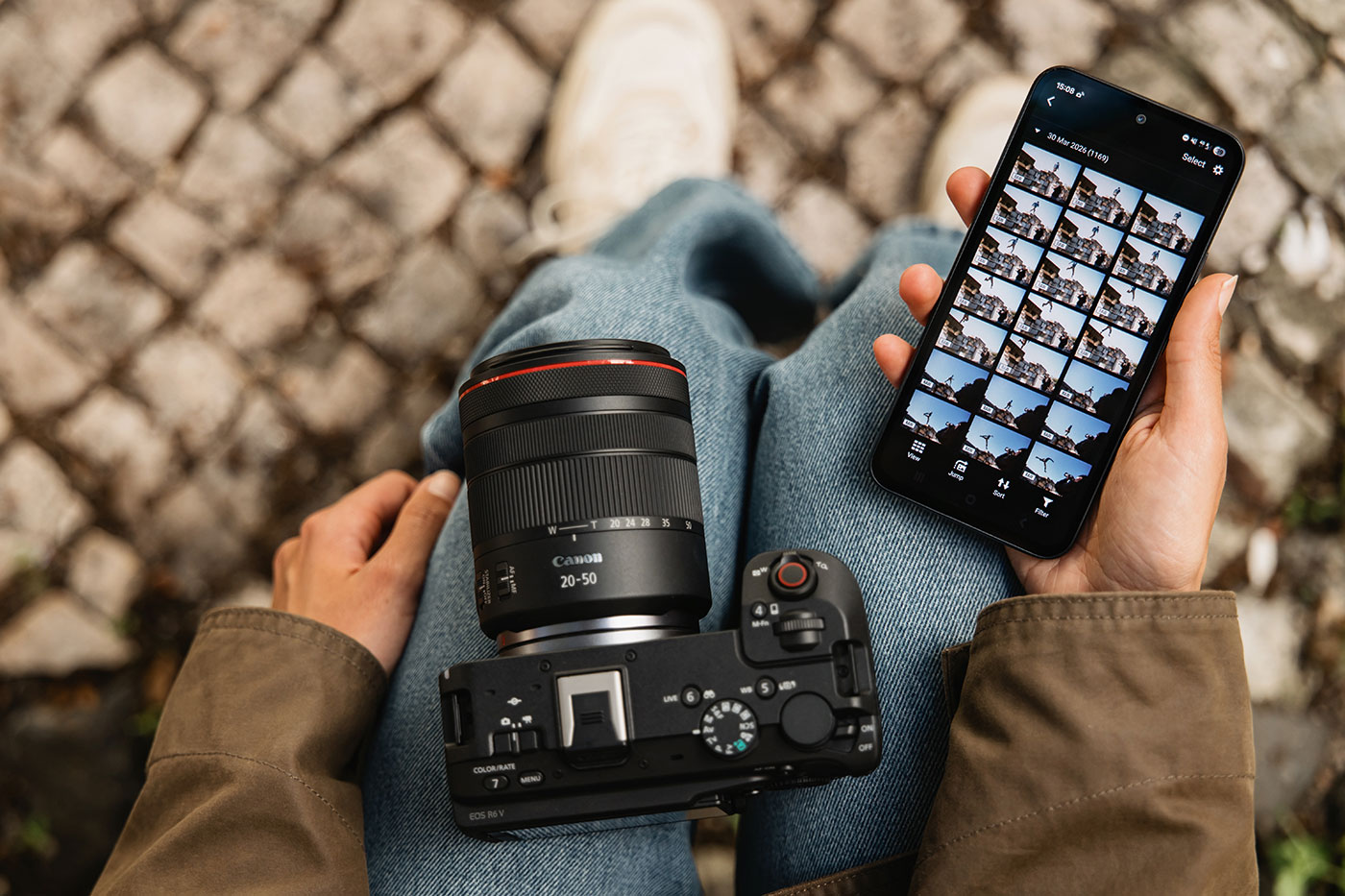
What is the Canon RF 20-50mm F4 L IS USM PZ Lens?
The newly released RF 20-50mm F4 L IS USM PZ is a power zoom lens primarily for video-first creators and filmmakers. It is one of a handful of RF mount lenses to offer integrated power zoom functionality, combined with the benefits of premium L-series build quality.
With a versatile wide-to-standard focal range, it is suitable for a broad variety of film styles, including vlogging, interviews, establishing shots, and more. Canon has utilised an advanced optical design that delivers high image quality, along with a nine-blade iris for smooth bokeh and well-controlled focus breathing.
With 6 stops of compensation, the lens-based stabilisation system is very effective, increasing to a maximum of 8 stops when paired with camera IBIS. This makes it a brilliant lens for walk-and-talk videos, vlogs, and action sequences where you want to shoot handheld without any rigging.
The power zoom can be controlled in a variety of ways, including from the lens itself, select camera bodies, or remotely. The zoom speed is variable, it offers effective weather resistance, and benefits from a compact 67mm filter thread, which brings us neatly on to accessories for the camera.
What are the best accessories for the R6 V?
Canon has released a compact Tripod Grip HG-200TBR alongside the camera, which is useful for handheld filming, self-recording, and remote control, thanks to the included Bluetooth Remote Controller BR-E2. You can buy the remote separately if you don't need the mini tripod, but it's especially handy for vloggers and solo creators.
Other accessories include a dedicated external video microphone, which can significantly enhance audio quality while offering options such as wireless audio and dual transmitters for interviews. You can also pick up a pair of headphones for monitoring, as there's a dedicated headphone jack on the body.
Don't forget to invest in a high-speed SD card or, ideally, a CFexpress card (Type B) if you don't already have one, and some form of camera bag is essential for anyone filming on location.
The Canon EOS R6 V follows a recent trend, but it's much more than simply a Canon vlogging camera. With a video-first body design, vertical UI support, and pro-level video recording, it is capable of taking a creator from beginner right through to professional.
Whether you livestream, create tutorials and learning material, or produce client work for established brands, the Canon EOS R6 V will support you every step of the way, all while offering robust features and build quality for busy schedules.
Thanks to Open Gate 7K/60p recording, internal RAW, and highly effective IBIS, you can run and gun without traditional filmmaking accessories when needed. This camera fills a gap in Canon's mirrorless lineup very effectively, and makes a compelling choice for video-first content creators who want top-notch quality without the learning curve, or price, of a cinema rig.
If you're ready to take the next step, explore the product details using the links below:
- Canon EOS R6 V Body Only
- Canon EOS R6 V with RF 20-50mm PZ Lens Kit
- Canon RF 20-50mm F4 L IS USM PZ Lens
Share this post:
By Nick Dautlich on 12/05/2026

Nick Dautlich
Senior Content Writer and Product Reviewer
Nick Dautlich is the Senior Content Writer and Product Reviewer at Park Cameras, with over 15 years of photography experience. A Sony Imaging Professional and expert reviewer, Nick has worked with major brands such as Canon, Sony and Nikon. His work is also featured on Vanguard World UK’s website, Capture Landscapes, and Shutter Evolve. Nick’s photography includes National Trust projects and magazine covers and he is passionate about landscapes and storytelling. Nick also enjoys hiking and teaching his children about nature. Learn more on his profile page.
Trade in your old equipment
Fast and easy trade in service ensures your old gear is collected efficiently and you are paid quickly! It's very simple to trade in your unwanted photography gear. Just head over to our dedicated Sell or Part Exchange page, fill out the details, and we'll get back to you with an offer for your old gear. Take the cash, or put it towards the cost of your new gear. It's up to you! Find out more
sign up to the newsletter
Keep up to date on the latest photography news, events and offers. Sign up now