- Call us 01444 237070

-
- Back
- Used Cameras
- Used Accessories
- Used Lenses
- Back
- Used Canon Lenses
- Used Nikon Lenses
- Used Fujifilm Lenses
- Used Sony Lenses
- Used Micro 4/3rds Lenses
- Used Leica Lenses
- Used Panasonic Lenses
- Used Pentax Lenses
- Used Samyang Lenses
- Used Sigma Lenses
- Used Tamron Lenses
- Used Tokina Lenses
- Used Voigtlander Lenses
- Used Zeiss Lenses
- Used Hasselblad Lenses
- Used Video
- Used Film Equipment
- Used Stock Alert
- Used Blank Test
- Sell or Part Exchange
- Used Clearance
- Recently Added Used Equipment
- Park Picks
- Faulty
- Trade-In
- Blog
- New in
- Call us
- Contact us
- Stores
- Sign in
- Categories
- Tips & Inspiration
- Reviews
- News
- Events
- Features
- Buying Guides
- Competitions
Tamron 35-100mm vs 35-150mm Comparison
With the arrival of the Tamron 35-100mm f/2.8 Di III VXD, Tamron now offers two high-performance zoom lenses covering 35mm to short telephoto, which may spark your interest. The newer 35-100mm goes head to head with the well established 35-150mm F/2-2.8 Di III VXD and both are available for Sony E and Nikon Z mirrorless cameras, but they serve slightly different needs.
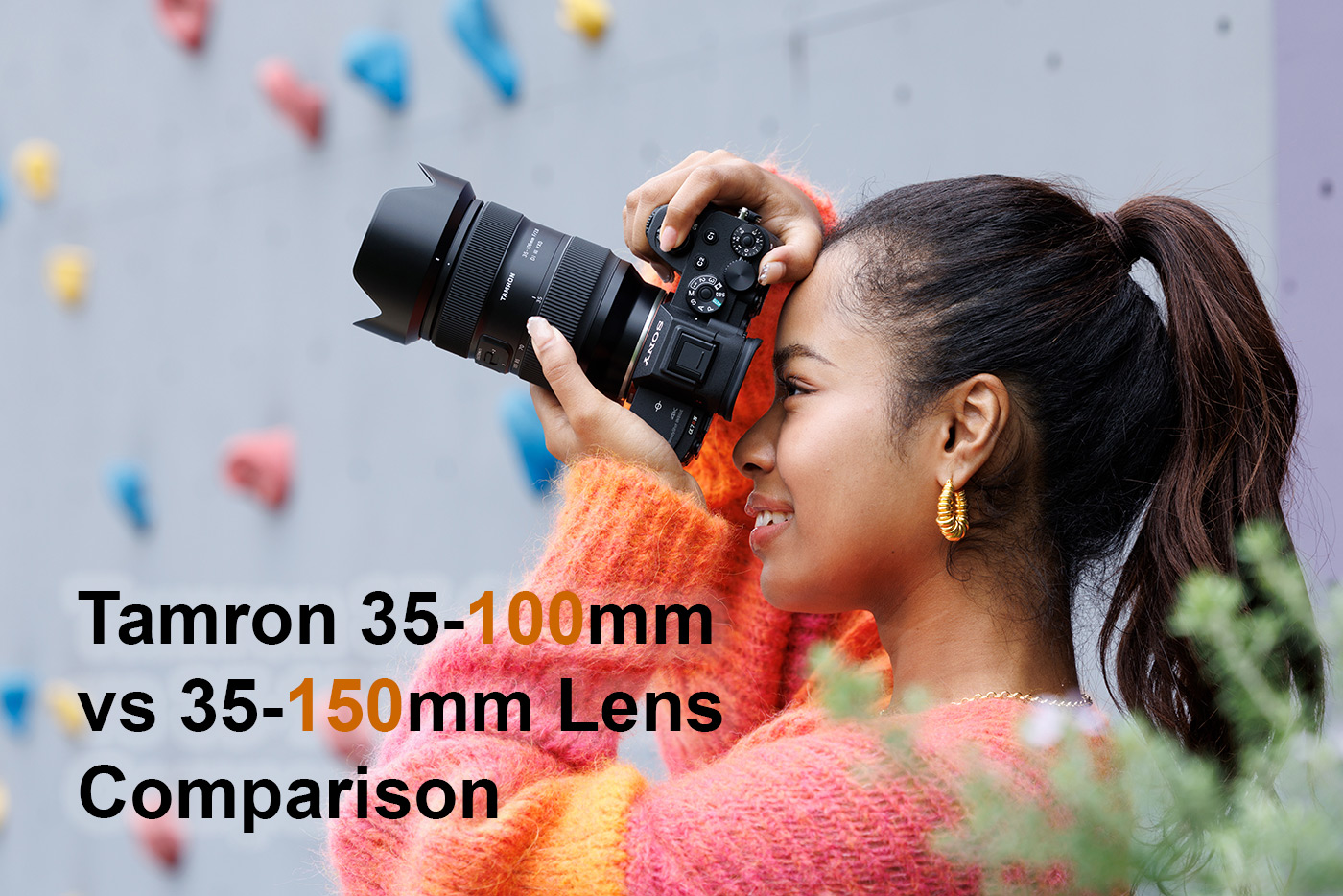
This Tamron 35-100mm vs 35-150mm comparison explores focal range, aperture differences, size, weight, price and controls in a comprehensive side-by-side specs comparison. We also look at which Tamron zoom lens makes more sense depending on how, and what you shoot.
Join us whether you’re deciding between these two Tamron lenses, or here simply to discover how each one fits into Sony and Nikon ecosystems.
Release dates and price
Before diving into specs, it’s worth noting the price difference between these two options so you can choose the best Tamron lens for your budget. The newer 35-100mm f/2.8 Di III VXD lens launched on 19th Feb 2026 and costs £799.00 for both Sony and Nikon versions.
The 35-150mm F/2-2.8 Di III VXD has been around since late 2021 and costs £1399.00 in E-mount, or £1599.00 for Nikon Z-mount. This represents quite a difference, with the 35-100mm lens offering a significant price advantage, albeit at the cost of 50mm reach at the long end.
With prices out of the way, let’s move straight to the specs comparison to discover how they compare on paper.

35-100mm f/2.8 Di III VXD sample image no Exif data
Tamron 35-100mm f/2.8 vs 35-150mm f/2.8 Lens Specs Comparison
If you are deciding between these two Tamron zoom lenses, the table below shows how their specifications translate into real-world features, with key differences between them.
|
Feature |
35-100mm F/2.8 (new) |
35-150mm F/2-2.8 |
|
Model |
A078 |
A058 |
|
Format |
Full-frame mirrorless |
Full-frame mirrorless |
|
Focal Length |
35-100mm |
35-150mm |
|
Maximum Aperture |
F2.8 |
F2-2.8 |
|
Aperture Blades |
9 |
9 |
|
Focus System |
VXD (Voice-coil eXtreme-torque Drive) |
VXD (Voice-coil eXtreme-torque Drive) |
|
Optical Construction |
15 elements in 13 groups |
21 elements in 15 groups |
|
Minimum Focus Distance |
0.22m (wide) / 0.65m (tele) |
0.33m (wide) / 0.85m (tele) |
|
Maximum Magnification |
1:3.3 (wide) / 1:5.9 (tele) |
1:5.7 (wide) / 1:5.9 (tele) |
|
USB-C Port |
Yes |
Yes |
|
Tamron Lens Utility Support |
Yes |
Yes |
|
Aperture Ring |
No |
Yes (Sony version) |
|
Aperture Ring Lock |
No |
Yes (Sony version) |
|
De-click Aperture Ring |
No |
Yes (Sony version) |
|
Customisable Button |
No |
Yes (Sony version) |
|
Moisture-resistant Construction |
Yes |
Yes |
|
Fluorine Coating |
Yes |
Yes |
|
Filter Size |
67mm |
82mm |
|
Maximum Diameter |
80.6mm |
89.2mm |
|
Length (Sony) |
119.2mm |
158mm |
|
Length (Nikon) |
121.5mm |
160.1mm |
|
Weight (Sony) |
565g |
1,165g |
|
Weight (Nikon) |
575g |
1,190g |
|
Price (Sony) |
£799.00 |
£1399.00 |
|
Price (Nikon) |
£799.00 |
£1599.00 |

35-100mm f/2.8 Di III VXD sample image no Exif data
Looking at these side by side, we see that the biggest differences are weight, reach and price. The 35-150mm gives you an extra 50mm and a brighter F2 aperture (at the wide end), but it is almost twice the weight and as noted earlier, considerably more expensive.
The 35-100mm is smaller, lighter and more affordable, while still maintaining a constant f/2.8, from the 9-bladed aperture. But what can you do with the extra telephoto reach of the longer zoom? We find out the strengths and weaknesses of each next.

35-100mm f/2.8 Di III VXD sample image no Exif data
Choosing the Right Zoom Lens for Your Subjects
Both of these lenses cover the same ground at the shorter end of the zoom range, spanning hugely useful 35mm, 50mm and 85mm focal lengths. This allows you to capture subjects such as:
- Portraits / environmental portraits
- Family and lifestyle
- Weddings and events
- Street
- Food
- Product
- Travel
The newer 35-100mm lens specialises in portrait-type genres, and it can also focus closer to the subject, with higher magnification. That can make it easier to fill the frame and capture more detail in certain situations.

The 35-150mm on the other hand, opens up different creative possibilities around similar subjects. It spans 105mm and 135mm focal lengths, which are ideal not just for portraits but also other genres that benefit from closer framing with more defined background separation. The extra 50mm at the long end gives you more working distance, which is useful when you cannot move closer to your subject. This added reach also renders stronger compression with more flexibility for concerts, stage performances or events where shooting from further back is a possibility.
A 135mm lens can isolate subjects beautifully with very compressed backgrounds too, which we explore in more detail in our guide to the many possibilities of 135mm lens. It also caters to video more readily with the Sony version featuring a de-clickable dedicated aperture ring, which is ideal for hybrid creators.
Choosing between these two will come down to a few factors, which we explore next.

35-100mm f/2.8 Di III VXD sample image no Exif data
How to choose between the 35-100mm and 35-150mm?
If you are a portrait, lifestyle or wedding photographer who wants the lightest possible kit, the 35-100mm could be the best choice. Likewise, you may be an amateur or enthusiast who wants a single zoom lens that spans useful focal lengths but comes in far lighter and more cost effectively than individual primes.
On the other hand, the 35-150mm is better suited to photographers and hybrid creators who want broader coverage from a single zoom, irrespective of price and weight. It allows for more versatility when shooting from different positions, covering more subjects from further away, but at the cost of weight, which could be off-putting if you shoot long days.
It’s worth weighing up these factors when deciding between them. If you use Lightroom Classic you can filter your images by focal lengths to help you decide which could be best for your needs.

Street scene at night with the 35-100mm f/2.8 Di III VXD no Exif data
Tamron Lens Utility
Both lenses include a built-in USB-C port, which allows connection to the Tamron Lens Utility for firmware updates and customisation. This enables adjustments such as focus preset settings and focus ring behaviour without sending the lens away.
For those who prefer a cable-free setup, the newly released Tamron-Link Bluetooth Adapter provides wireless control via the Tamron Lens Utility Mobile app for iOS and Android. Once connected, compatible lenses can be configured from a smartphone, adding flexibility for tripod shooting and video control.
Compatibility depends on lens version and mount, so it is worth checking if your specific Tamron lens supports Lens Utility before purchase.

35-100mm f/2.8 Di III VXD sample image no Exif data
While the Tamron 35-100mm and 35-150mm cover similar ground at the wide end, they serve slightly different users. The 35-100mm targets those who want portability and value, while the 35-150mm adds reach, a brighter F2 at 35mm and more control.
Both are great options from Tamron, with high image quality achievable from either.
If you are updating your kit, remember to get an instant free trade-in quote for the equipment you’re selling, to help offset the cost.
Explore the Tamron 35-100mm F/2.8 Di III VXD Lens For Sony E or the 35-100mm F/2.8 Di III VXD Lens For Nikon Z today.
Share this post:
By Nick Dautlich on 19/02/2026

Nick Dautlich
Senior Content Writer and Product Reviewer
Nick Dautlich is the Senior Content Writer and Product Reviewer at Park Cameras, with over 15 years of photography experience. A Sony Imaging Professional and expert reviewer, Nick has worked with major brands such as Canon, Sony and Nikon. His work is also featured on Vanguard World UK’s website, Capture Landscapes, and Shutter Evolve. Nick’s photography includes National Trust projects and magazine covers and he is passionate about landscapes and storytelling. Nick also enjoys hiking and teaching his children about nature. Learn more on his profile page.
Trade in your old equipment
Fast and easy trade in service ensures your old gear is collected efficiently and you are paid quickly! It's very simple to trade in your unwanted photography gear. Just head over to our dedicated Sell or Part Exchange page, fill out the details, and we'll get back to you with an offer for your old gear. Take the cash, or put it towards the cost of your new gear. It's up to you! Find out more
sign up to the newsletter
Keep up to date on the latest photography news, events and offers. Sign up now