- Call us 01444 237070

-
- Back
- Used Cameras
- Used Accessories
- Used Lenses
- Back
- Used Canon Lenses
- Used Nikon Lenses
- Used Fujifilm Lenses
- Used Sony Lenses
- Used Micro 4/3rds Lenses
- Used Leica Lenses
- Used Panasonic Lenses
- Used Pentax Lenses
- Used Samyang Lenses
- Used Sigma Lenses
- Used Tamron Lenses
- Used Tokina Lenses
- Used Voigtlander Lenses
- Used Zeiss Lenses
- Used Hasselblad Lenses
- Used Video
- Used Film Equipment
- Used Stock Alert
- Used Blank Test
- Sell or Part Exchange
- Used Clearance
- Recently Added Used Equipment
- Park Picks
- Faulty
- Trade-In
- Blog
- New in
- Call us
- Contact us
- Stores
- Sign in
- Categories
- Tips & Inspiration
- Reviews
- News
- Events
- Features
- Buying Guides
- Competitions
UK Astrophotography Highlights April 2026
Images ©Jonathan Penberthy
We are well and truly in to Galaxy season this month as the centre of the Milkyway is out of our night sky until right before dawn. This means our abilities here in the UK are quite limited to capture anything more than the Moon, Planets and Galaxies, all being well the odd spaceship too!
NASA have re-scheduled Artemis II launch to 2324 (BST) 1st April and despite the date, this isn't a joke and looks like it will be going ahead, further information about the flight can be seen here.
Theoretically if it is launched we should be able to see the rocket pass overhead around midnight and then about every 90 mins or so inline with the plan.
If you wish to read about imaging this event then please check out this blog.
On 11th April I shall be giving a talk on Celestial Navigation at Eastbourne Astronomical Societies monthly lecture. You are all very welcome to attend!
Last Months Challenge.
Obviously Artemis was delayed again, so this time I thought I would take the time to try and photograph some Dark Nebula. Essentially a thick cloud of cosmic dust and gas that blocks the light behind it. When you look at one, you’re not seeing an empty patch of sky — you’re seeing a cloud so dense that starlight can’t get through. That’s why they appear as dark shapes against the brighter background of the Milky Way.
Inside these clouds, the temperature is extremely low and the material is packed closely enough that gravity can start pulling things together. This makes dark nebulae important because they’re often the places where new stars begin to form. They’re like the quiet, hidden workshops of the galaxy where future solar systems are assembled.
Some are small and isolated, others stretch across huge regions of space, creating the dark lanes and silhouettes you see in wide‑field astrophotography. Their shapes can be dramatic — twisting filaments, animal‑like outlines, or simple patches of shadow — but they all work the same way: they block light, hide what’s behind them, and cradle the early stages of star formation.
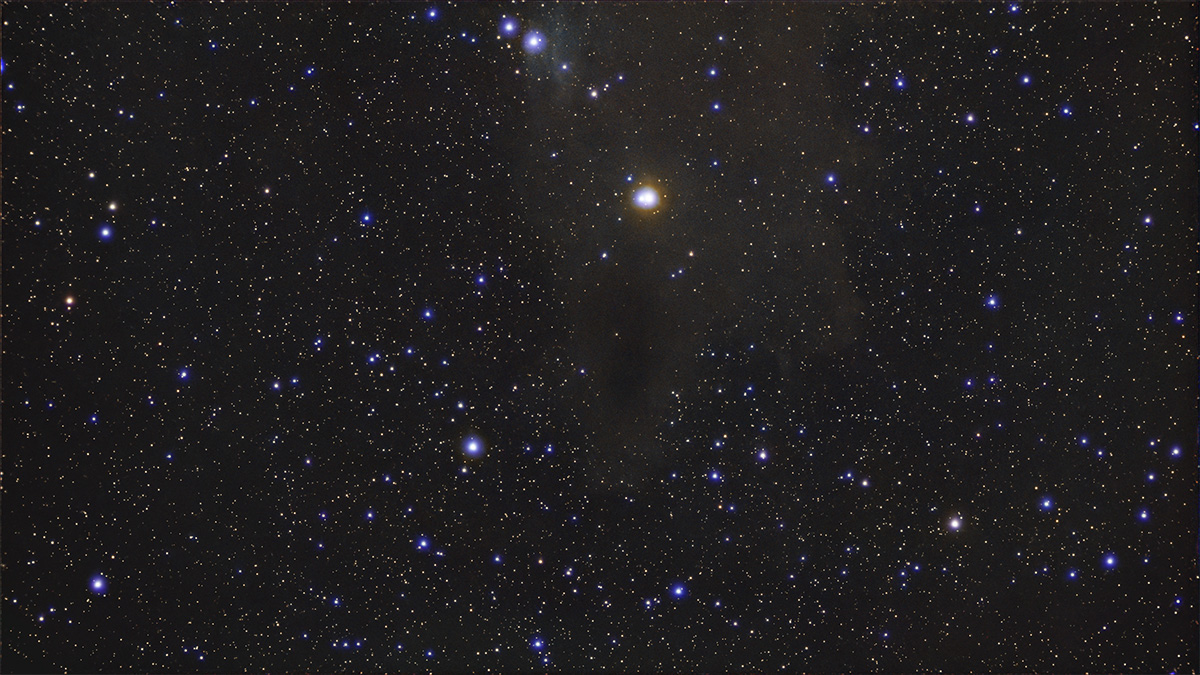
The Dark Shark - LDN 1235
The Dark Shark Nebula is a large, shadowy cloud of dust and gas in the constellation Cepheus, and it gets its name because its outline genuinely resembles a shark gliding through space. What makes it striking is not light, but darkness: the dust inside it is so thick that it blocks the starlight behind it, carving out the shape of a shark’s head, body, and tail against the brighter star field around it.
Even though it looks like a silhouette, the nebula is part of a much larger, active region of the galaxy where new stars are forming. The dust and gas inside it are slowly collapsing under gravity, and young stars are beginning to take shape within the cloud. Some nearby stars also scatter their light off the surrounding dust, creating faint patches of reflection nebulae near what looks like the shark’s “eye.”
The whole structure spans roughly fifteen light‑years and sits a few hundred light‑years from Earth — close enough that long‑exposure astrophotography can reveal its delicate textures, but faint enough that capturing it is notoriously challenging. Its darkness, subtle gradients, and almost colourless appearance make it one of those targets that demands patience, long integration times, and very clean skies.
What makes the Dark Shark so compelling is the contrast between its appearance and its purpose: it looks like a void, but it’s actually a cradle for new stars, quietly shaping the next generation of the galaxy. However as you can see in my image due to the lack of integration time (2 hours) and it being relatively low to the horizon, my field of view being limited to the head of the shark, it didn't exactly go to plan!
Exif
Camera: ZWO ASI585MC Pro.
Telescope: Altair Astro 70ED Telescope (420mm).
Mount: Sky-Watcher EQ5 Pro
Filter: UV/IR Cut
Guide Camera: ZWO ASI120mm-s
Guide Scope: SVBony 30mm (f4)
Computer: ZWO ASIAIR pro
Method:
Lights: 60 x 120 sec Gain 252.
Darks: 0
Flats: 0
Bias: 0
Stacked in DSS, Processed in Pixinsight with RC-Astro Suite of tools. Finishing touches in Photoshop.
So next I though I might try another one higher up in the sky:
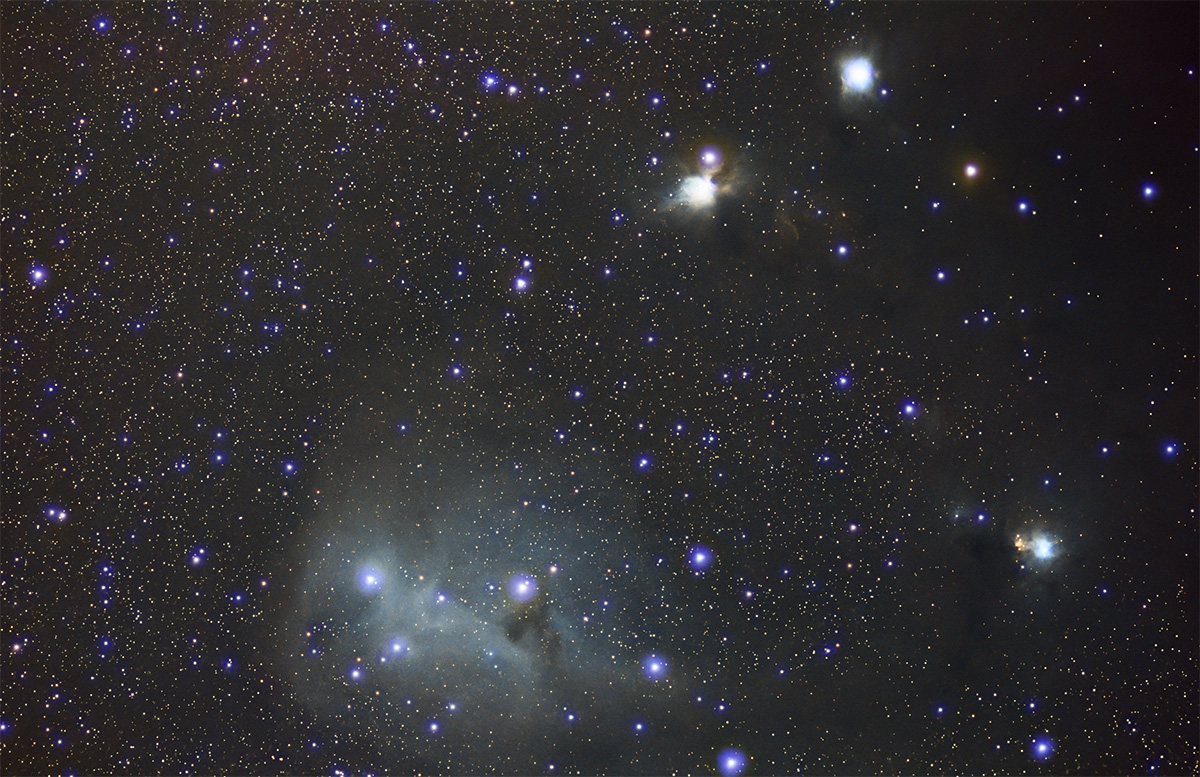
Dreyer's Nebula - IC2169
Technically a small reflection nebula in the constellation Monoceros, not a true Dark Nebula. Most of its light comes from nearby young stars, which scatter off the fine dust in the cloud and give it a soft, bluish glow. That reflective quality is what makes it stand out in long‑exposure images.
Mixed into the same region are patches of much denser dust that don’t reflect light at all. Those areas behave like dark nebulae — they block the background starlight and create little pockets of shadow threaded through the brighter material. The combination of glowing dust and dark lanes gives the whole area a layered, textured look.
So given my kit and abilities, I feel that this creates a far better image than my attempt of the Dark Shark, and yes the sharp ones amongst you will notice I have 2.5 times as much data!
Exif
Camera: ZWO ASI585MC Pro.
Telescope: Altair Astro 70ED Telescope (420mm).
Mount: Sky-Watcher EQ5 Pro
Filter: UV/IR Cut
Guide Camera: ZWO ASI120mm-s
Guide Scope: SVBony 30mm (f4)
Computer: ZWO ASIAIR pro
Method:
Lights: 150 x 120 sec Gain 252.
Darks: 0
Flats: 0
Bias: 0
Stacked in DSS, Processed in Pixinsight with RC-Astro Suite of tools. Finishing touches in Photoshop.
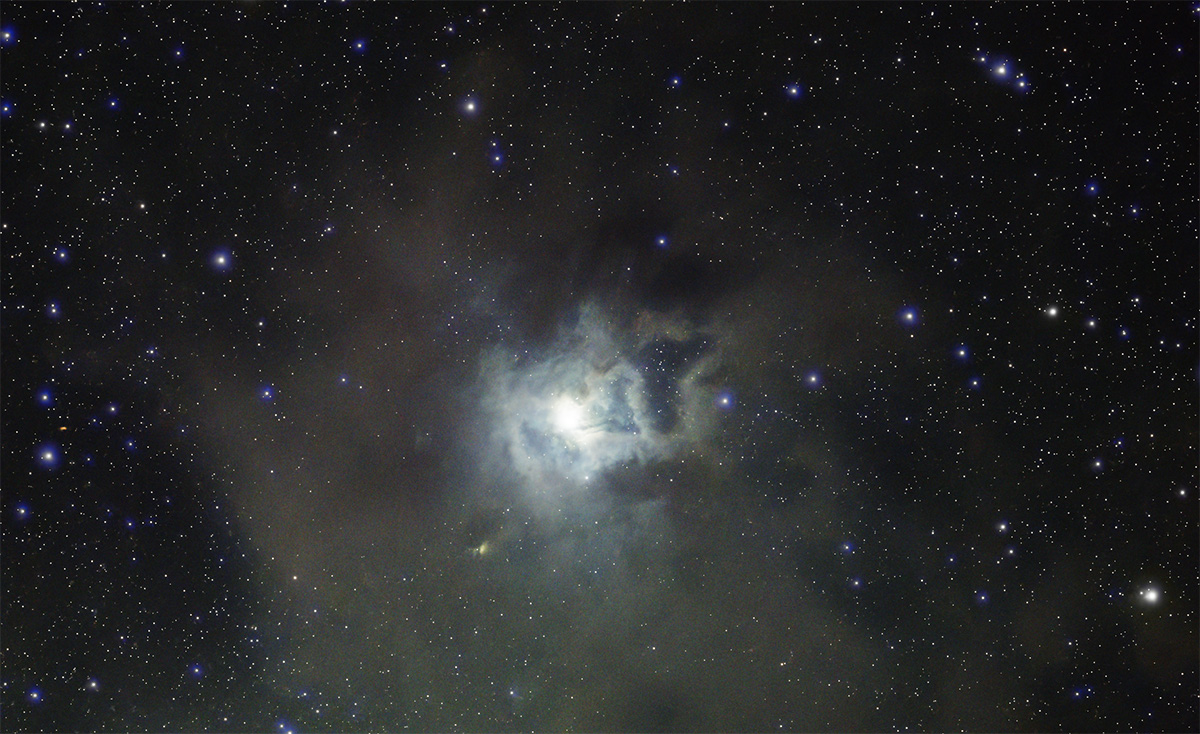
Iris Nebula - NGC 7023 / LBN 487 / Caldwell 4
The Iris Nebula is a bright reflection nebula in Cepheus, known for its striking blue glow. The colour comes from a young, hot star in the centre whose light scatters off the surrounding dust, almost like a spotlight shining through mist. Around that bright core, the nebula is wrapped in thick, dark dust that doesn’t reflect much light at all. Those darker regions give the whole scene a sense of depth, with the glowing centre fading into shadowy filaments.
It’s a beautiful mix of light and darkness: a crisp blue flower‑like core surrounded by soft, smoky dust clouds. Long‑exposure images reveal just how much faint material surrounds it, making it a favourite target for astrophotographers who enjoy capturing subtle detail.
Exif
Camera: ZWO ASI585MC Pro.
Telescope: Altair Astro 70ED Telescope (420mm).
Mount: Sky-Watcher EQ5 Pro
Filter: UV/IR Cut
Guide Camera: ZWO ASI120mm-s
Guide Scope: SVBony 30mm (f4)
Computer: ZWO ASIAIR pro
Method:
Lights: 60 x 120 sec Gain 252.
Darks: 0
Flats: 0
Bias: 0
Stacked in DSS, Processed in Pixinsight with RC-Astro Suite of tools. Finishing touches in Photoshop.
Lunar
Well the excitement of Artemis II is keeping me awake at night, in 48hrs all being well from the time of writing this blog we shall have human beings for the first time in 50 years on the way to the Moon.
Here is the Lunar calendar for April
And a photo I took in late February whilst dreaming of these astronauts flying around and back!
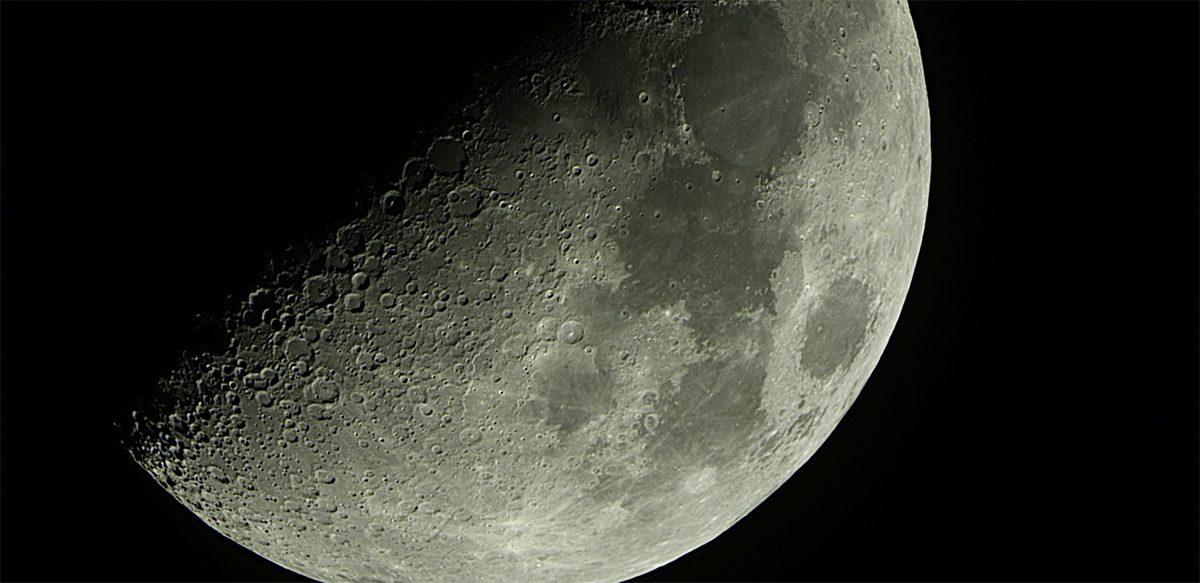
Exif
Camera: ZWO ASI585MC Pro.
Telescope: Altair Astro 70ED Telescope (420mm).
Mount: Sky-Watcher EQ5 Pro
Filter: UV/IR Cut
Guide Camera: ZWO ASI120mm-s
Guide Scope: SVBony 30mm (f4)
Computer: ZWO ASIAIR pro
Method:
Lights: 10 sec video, gain 0.
Darks: 0
Flats: 0
Bias: 0
Processed in Autostakkert/Pixinsight with RC-Astro Suite of tools. Finishing touches in Photoshop.
Deep Sky
As mentioned earlier, Galaxy Season is here, and so it gives us chance to practice our skills of capturing these wondrous celestial bodies. I don't find them all that interesting, other than the marvel that they are another galaxy far away from our own, and like to think that somewhere there are other intergalactic star gazing geeks staring right back at us who are longing too for the rich array of nebulae our home galaxy has to come back into view.
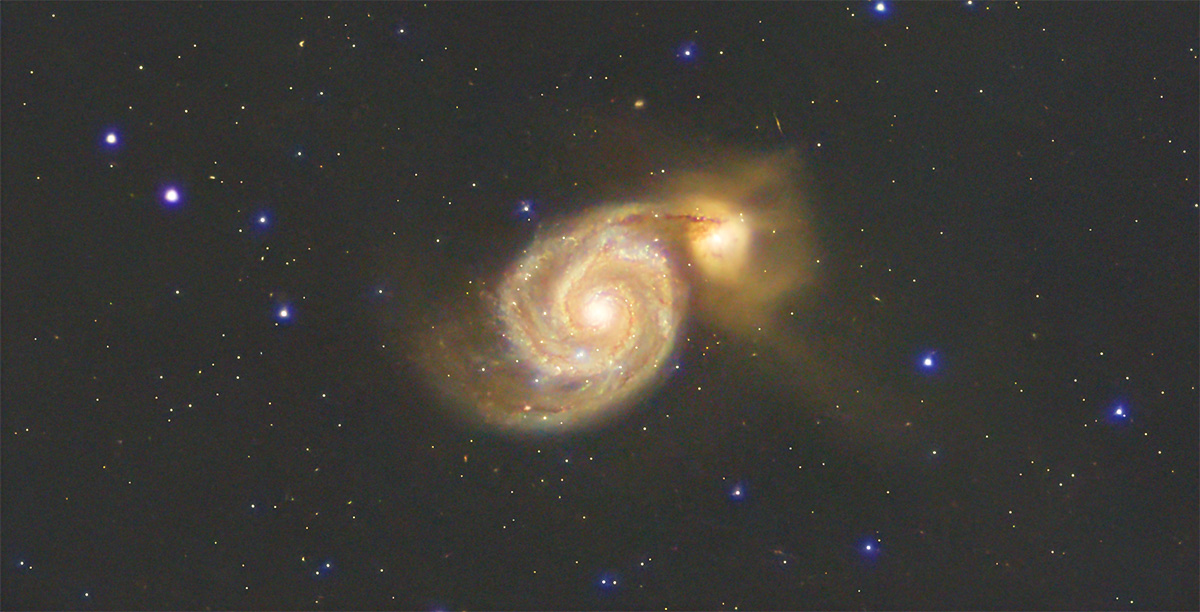
The Whirlpool Galaxy - M51
M51 is one of the most recognisable galaxies in the night sky because its structure is so beautifully defined. It’s a classic face‑on spiral galaxy, which means we’re looking straight down onto its spiral arms rather than from the side. That gives it a striking, pinwheel‑like appearance.
What makes M51 especially interesting is its interaction with a smaller companion galaxy that’s tugging on one of its arms. That gravitational pull stretches and distorts the spiral pattern, creating the dramatic shape that earned it the nickname “the Whirlpool.” The bright core, sweeping arms, and the bridge of material between the two galaxies make it a favourite target for astrophotographers.
Even though it’s around 30 million light‑years away, its structure is clear enough that amateur telescopes can pick out the main features. Long exposures reveal dust lanes, star‑forming regions, and the subtle tidal effects caused by the companion galaxy.
Whilst this to me is by far my best attempt yet at M51, it still has the opportunity for many an improvement. There is a lot of noise which I think can be sorted with more integration time, and many other Astro nerds seem to get a blue/violet hue from the main galaxy, and despite me turning the saturation up to the max, it cant be seen, I don't know if it is my UV/IR cut filter which is reducing this, and perhaps I need to man up and remove all filters... but anyway that is for me to figure out in the next few months.
Exif
Camera: ZWO ASI585MC Pro.
Telescope: Altair Astro 70ED Telescope (420mm).
Mount: Sky-Watcher EQ5 Pro
Filter: UV/IR Cut
Guide Camera: ZWO ASI120mm-s
Guide Scope: SVBony 30mm (f4)
Computer: ZWO ASIAIR pro
Method:
Lights: 60 x 120 sec Gain 252.
Darks: 0
Flats: 0
Bias: 0
Processed in Pixinsight with RC-Astro Suite of tools. Finishing touches in Photoshop.
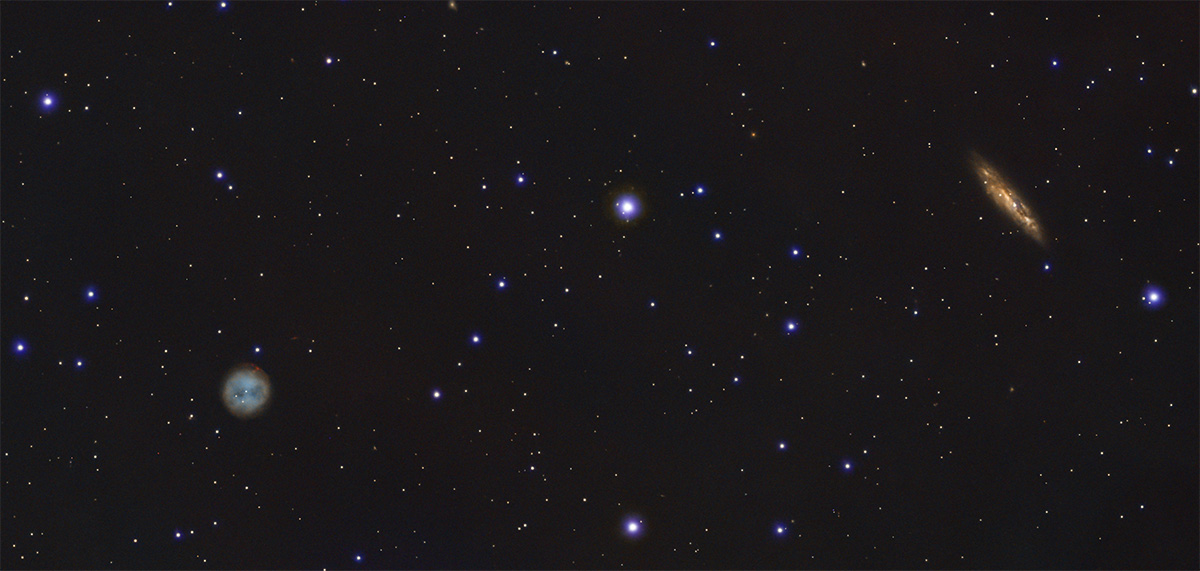
The Owl Nebula (M97) and M108
The Owl Nebula is a planetary nebula in Ursa Major, created from the outer layers of a dying star. Its name comes from the two darker “eye” shapes in the centre, which give it an owl‑like face. It’s a soft, round bubble of gas expanding into space, with subtle structure that shows the star’s final breaths. M108 sits close to the Owl Nebula in the sky but is completely different — it’s an edge‑on spiral galaxy. Because we see it from the side, it looks like a long, dusty streak with a bright core buried inside. Its uneven dust lanes and mottled texture make it a great contrast to the smooth glow of M97.
Exif
Camera: ZWO ASI585MC Pro.
Telescope: Altair Astro 70ED Telescope (420mm).
Mount: Sky-Watcher EQ5 Pro
Filter: UV/IR Cut
Guide Camera: ZWO ASI120mm-s
Guide Scope: SVBony 30mm (f4)
Computer: ZWO ASIAIR pro
Method:
Lights: 60 x 120 sec Gain 252.
Darks: 0
Flats: 0
Bias: 0
Processed in Pixinsight with RC-Astro Suite of tools. Finishing touches in Photoshop.
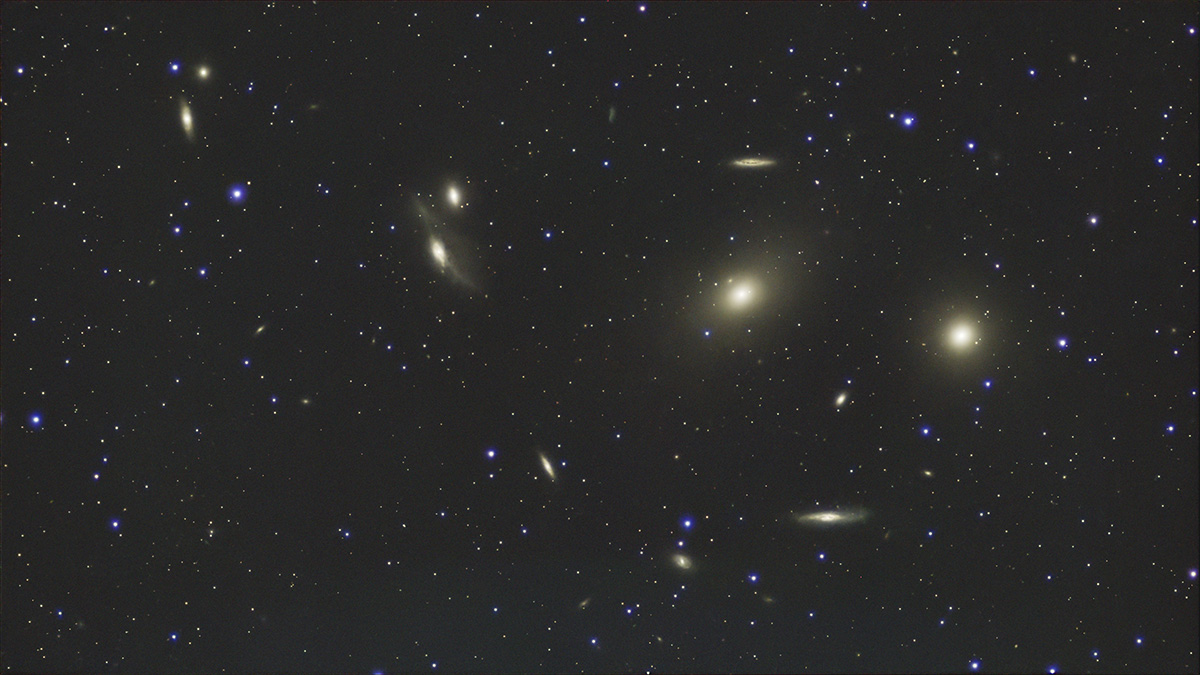
Markarians Chain
Markarian’s Chain is a graceful arc of galaxies that sits within the Virgo Cluster. When you look at this region through a telescope or in a long‑exposure image, the galaxies appear to line up in a smooth curve, almost as if they’re following a shared path across space. The group includes several bright ellipticals and lenticular, along with a few interacting pairs that add texture and interest to the field.
What makes the chain so appealing is the sense of motion and structure it creates. Even though the galaxies aren’t physically connected in a literal chain, many of them do share similar movement through the cluster, which is why they stand out as a coherent feature. The mix of shapes — from large, soft ellipticals to distorted spirals — gives the whole stretch a dynamic, almost sculpted look.
It’s a favourite region for wide‑field galaxy imaging because you’re not just capturing one object; you’re capturing a whole neighbourhood of galaxies arranged in a naturally elegant pattern.
Exif
Camera: ZWO ASI585MC Pro.
Telescope: Altair Astro 70ED Telescope (420mm).
Mount: Sky-Watcher EQ5 Pro
Filter: UV/IR Cut
Guide Camera: ZWO ASI120mm-s
Guide Scope: SVBony 30mm (f4)
Computer: ZWO ASIAIR pro
Method:
Lights: 60 x 120 sec Gain 252.
Darks: 0
Flats: 0
Bias: 0
Processed in Pixinsight with RC-Astro Suite of tools. Finishing touches in Photoshop.
The Seagull Nebula
The Seagull Nebula is a large, flowing cloud of gas and dust that stretches across the border of Monoceros and Canis Major. It gets its name because the whole structure looks like a seagull in flight, with a bright “head” region and long, sweeping “wings” made of glowing hydrogen gas.
Most of the nebula shines as an emission nebula, where energetic young stars light up the surrounding hydrogen and give it that soft red glow. Mixed into the same area are patches of darker dust that don’t emit light at all — they block the background stars and add contrast, giving the wings and body more definition. There are also small pockets of reflection nebula where starlight bounces off fine dust grains, adding hints of blue around the brighter regions.
It’s a rich, layered part of the sky: glowing gas, dark lanes, new-born stars, and subtle colour variations all woven together into a shape that really does resemble a bird gliding through space.
Now for those of you who know, this isn't in its natural colours, and nor have I used the SHO tool I have written in PixelMath (Pixinsight) to try and mimic this. Instead this is a one shot colour dedicated Astro camera with a couple of dual band filters and Pixinsight. I believe this to be technically my best image to date, and as close to the 'Hubble Palette' I can get with the kit I have.
Method:
Stack C2 filter subs in DSS as normal. Stack L eNhance subs as normal. Import the two images into Pixinsight. Split the channels on each, so that in the case of the C2 image SII is in red and OIII is in green and blue, in the case of L eNhance Ha is red and OIII are in green and blue. Combine all the Green and Blue channels from both images (4 channels worth total) in to one channel and call this OIII, then take the SII channel and put it in red channel in a new image, then Ha in the Green channel and lastly OIII in blue. Then process the image as normal.
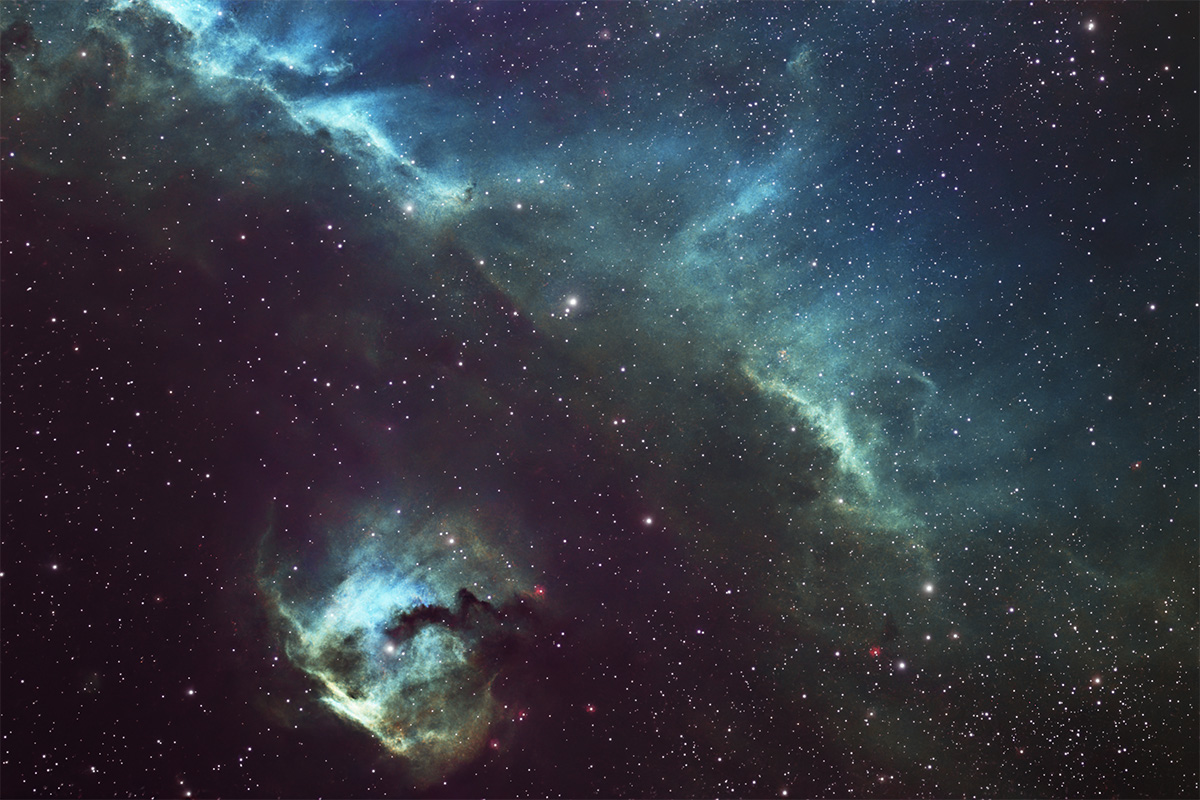
Camera: ZWO ASI585MC Pro.
Telescope: Altair Astro 70ED Telescope (420mm).
Mount: Sky-Watcher EQ5 Pro
Guide Camera: ZWO ASI120mm-s
Guide Scope: SVBony 30mm (f4)
Computer: ZWO ASIAIR pro
Method:
Lights: 60 x 120 sec Gain 252 Altair Astro C2 Filter (SII and OIII).
Lights: 60 x 120 sec Gain 252 Optolong L eNhance (Ha and OIII).
Darks: 0
Flats: 0
Bias: 0
Processed in Pixinsight with RC-Astro Suite of tools. Finishing touches in Photoshop.
Share this post:
By Jonathan Penberthy on 31/03/2026

Jonathan Penberthy
Cosmic Shutter Seeker and Star Programmer
Jonathan Penberthy is the Cosmic Shutter Seeker and Star Programmer at Park Cameras, with over 20 years of experience as a software engineer. His career journey has spanned industries, but a move to Park Cameras sparked a passion for astrophotography. Jonathan’s interest began while working on a lens selection app, leading him to explore the night sky with a Canon 7D. When he’s not programming or photographing the stars, he enjoys sailing and navigating by the cosmos. Learn more on his profile page.
Trade in your old equipment
Fast and easy trade in service ensures your old gear is collected efficiently and you are paid quickly! It's very simple to trade in your unwanted photography gear. Just head over to our dedicated Sell or Part Exchange page, fill out the details, and we'll get back to you with an offer for your old gear. Take the cash, or put it towards the cost of your new gear. It's up to you! Find out more
sign up to the newsletter
Keep up to date on the latest photography news, events and offers. Sign up now