- Call us 01444 237070

-
- Back
- Used Cameras
- Used Accessories
- Used Lenses
- Back
- Used Canon Lenses
- Used Nikon Lenses
- Used Fujifilm Lenses
- Used Sony Lenses
- Used Micro 4/3rds Lenses
- Used Leica Lenses
- Used Panasonic Lenses
- Used Pentax Lenses
- Used Samyang Lenses
- Used Sigma Lenses
- Used Tamron Lenses
- Used Tokina Lenses
- Used Voigtlander Lenses
- Used Zeiss Lenses
- Used Hasselblad Lenses
- Used Video
- Used Film Equipment
- Used Stock Alert
- Used Blank Test
- Sell or Part Exchange
- Used Clearance
- Recently Added Used Equipment
- Park Picks
- Faulty
- Trade-In
- Blog
- New in
- Call us
- Contact us
- Stores
- Sign in
Call us: 01444 237070
Search terms
Brands
Category
Products
[[{name}]]
[[{attributes.Price}]]
- Categories
- Tips & Inspiration
- Reviews
- News
- Events
- Features
- Buying Guides
- Competitions
UK Astrophotography Highlights May 2026
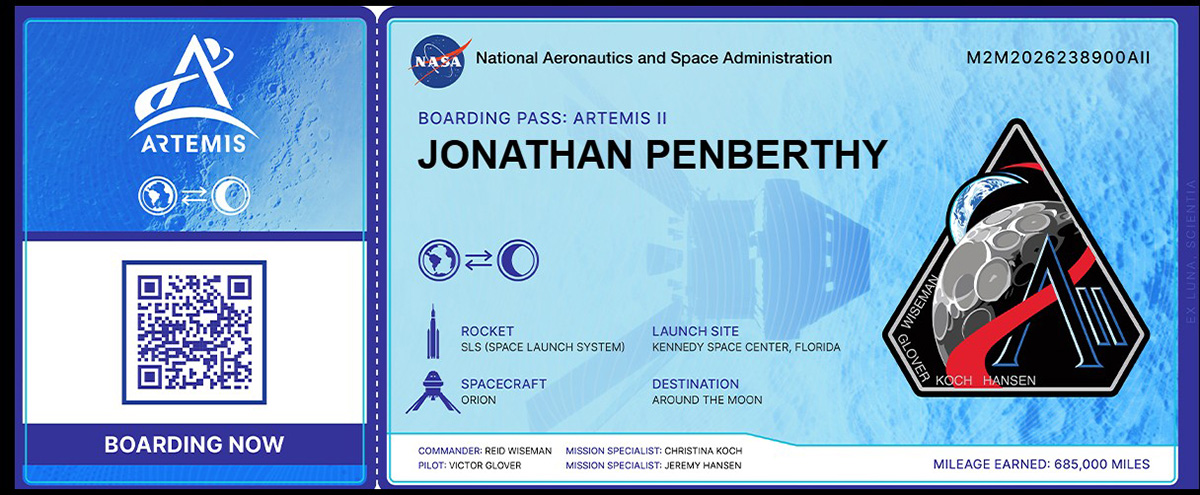
Main talk around the telescope this month has to be Artemis 2. No drama, no theatrics, just a disciplined flight that did exactly what it was supposed to do. The crew took Orion further than any humans have travelled not just in decades, but ever before at a massive 252,756 miles from Earth, pushed the systems hard, and brought everyone home in one piece!
What made the mission successful wasn’t a single headline moment but the overall consistency. The SLS performed cleanly, Orion handled deep‑space operations without any surprises, and the re‑entry profile showed the heat shield and guidance systems can cope with the speeds we’ll see on future lunar returns. The crew did their job with the kind of calm professionalism you only get when the hardware is behaving itself.
Artemis 2 essentially answered the question everyone had been asking since the programme started: can this stack carry people safely to the Moon and back. The mission delivered a clear yes. And now NASA can move forward with Artemis 3 knowing the fundamentals are solid will launch in 2027 into low Earth orbit and perform docking tests with one or both commercial landers (SpaceX Starship and Blue Origin Blue Moon). Then in 2028 we can look forward to seeing foot prints on the Moon again!
Meanwhile here in southern England we seem to have been blessed once again with more than our fair share of cloud, scuppering our chances of imaging those magical celestial wonders.
Last Months Challenge
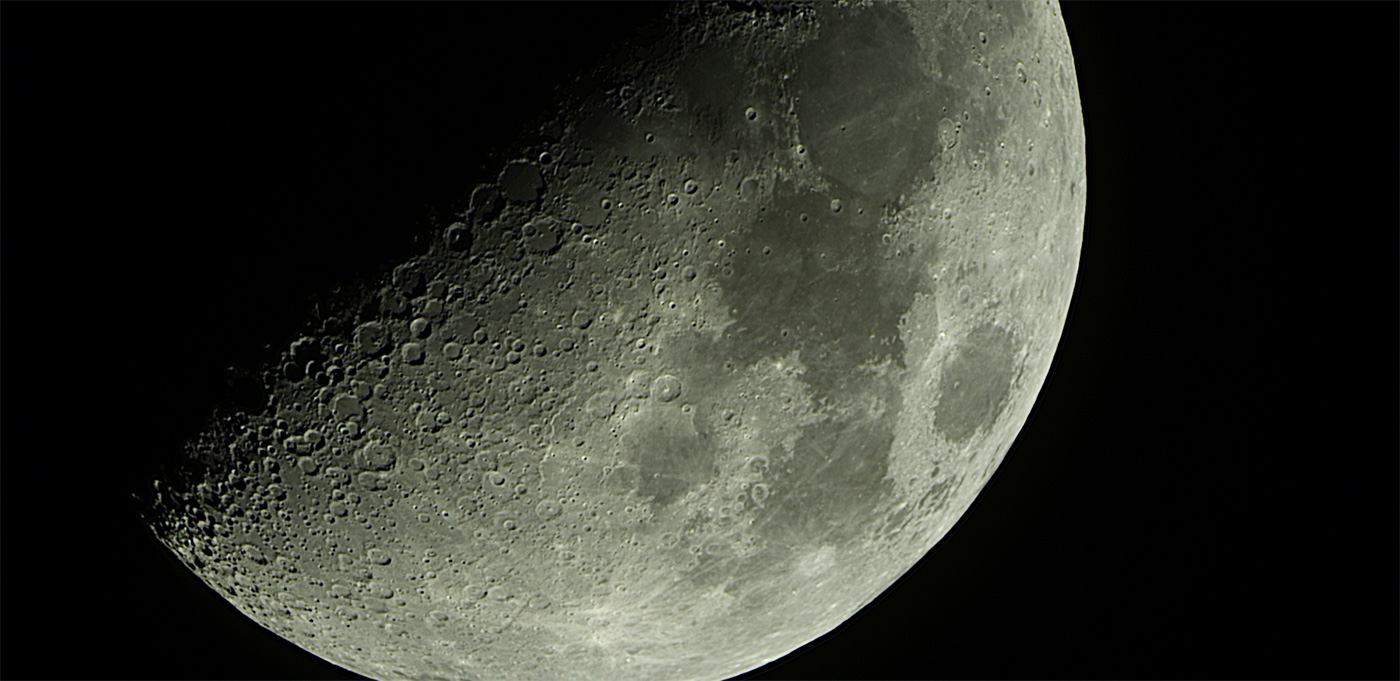
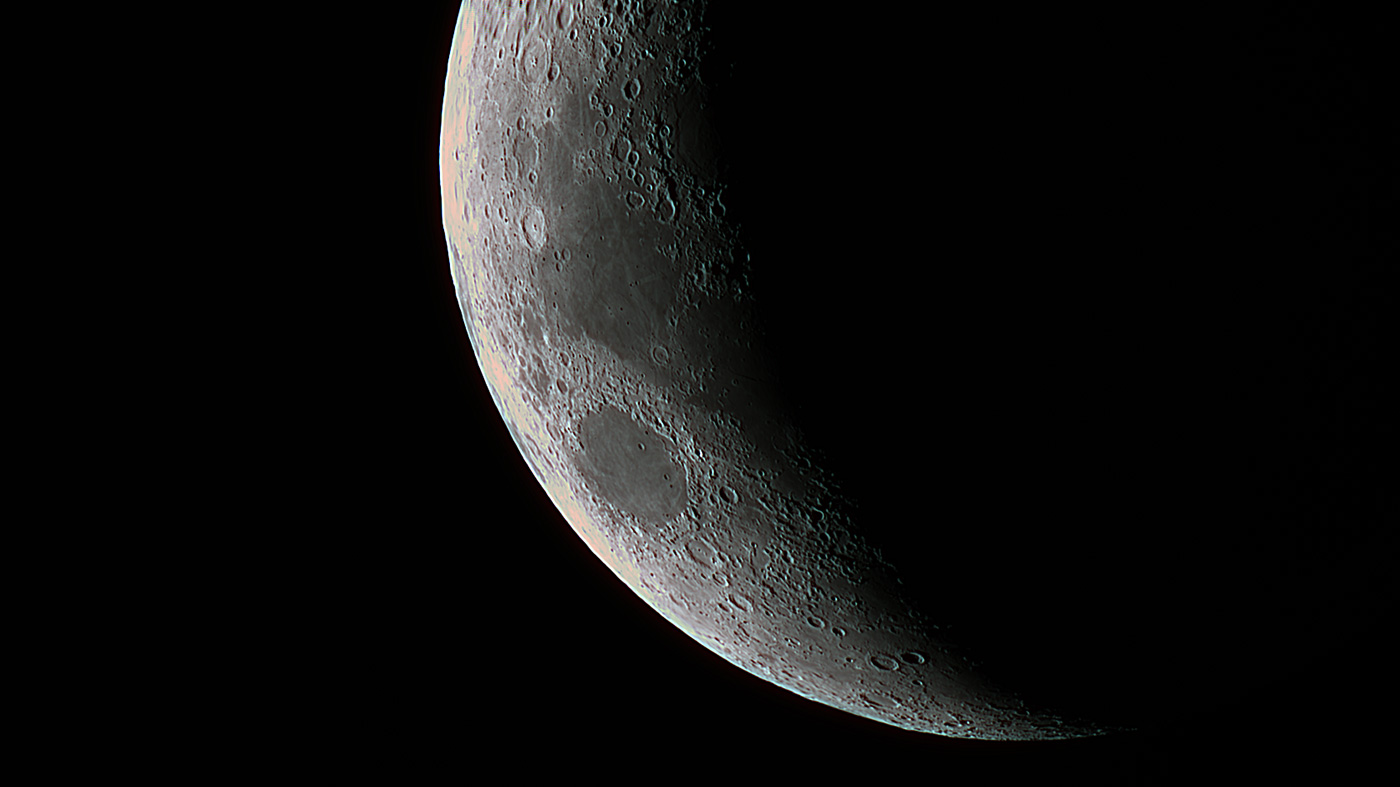
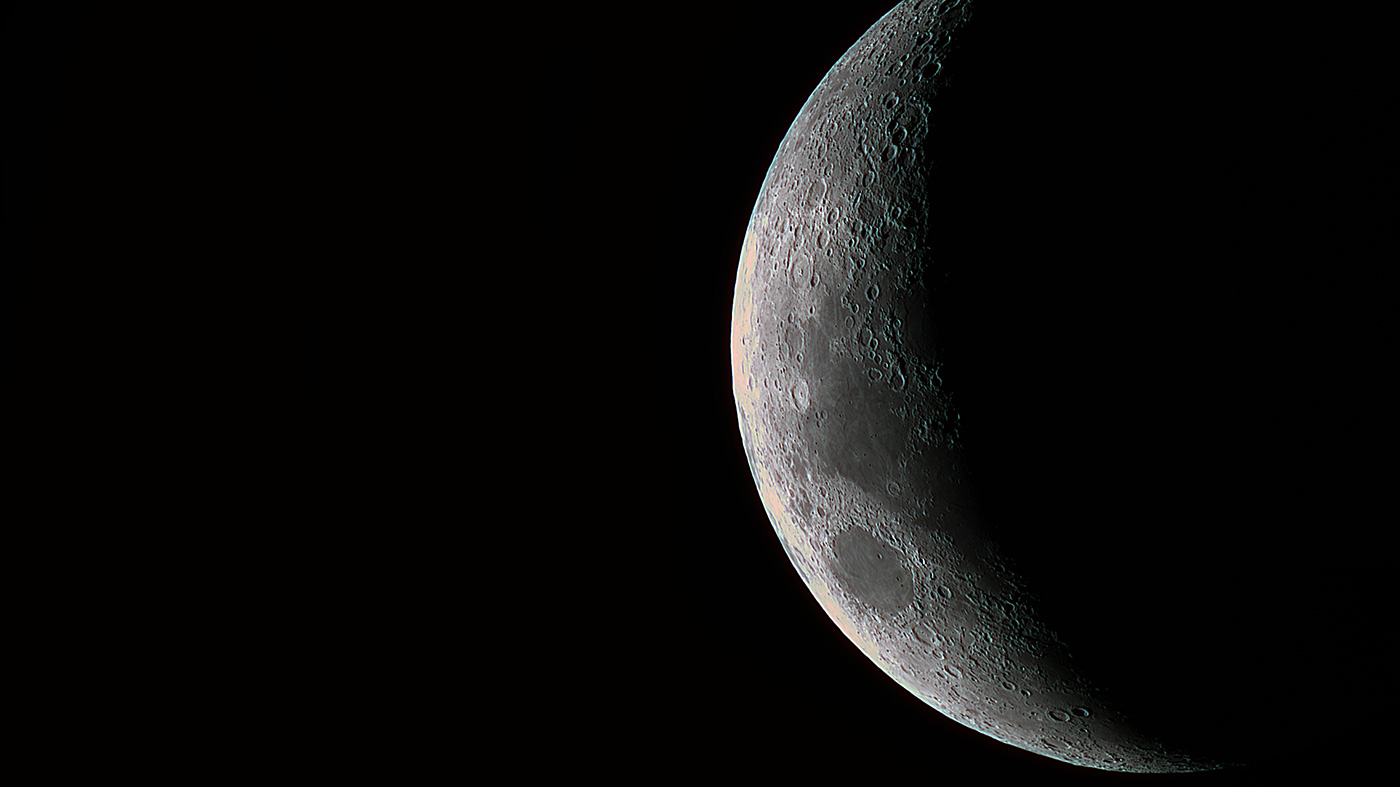
Artemis 2 made it to the moon and back, but due to a course change for reasons I do not know. Artemis instead of passing over the UK, stuck to a more equatorial trajectory, which made it impossible to capture from the UK, even without all the unwanted cloud. However as the Orion Spaceship approached the Moon and flew back I did try several times to capture it, but it escaped me. I just couldn't see it. But I did take some lovely moon shots!
On 6th April I took this one (Orion spaceship was some way out of frame, heading towards the Moon):
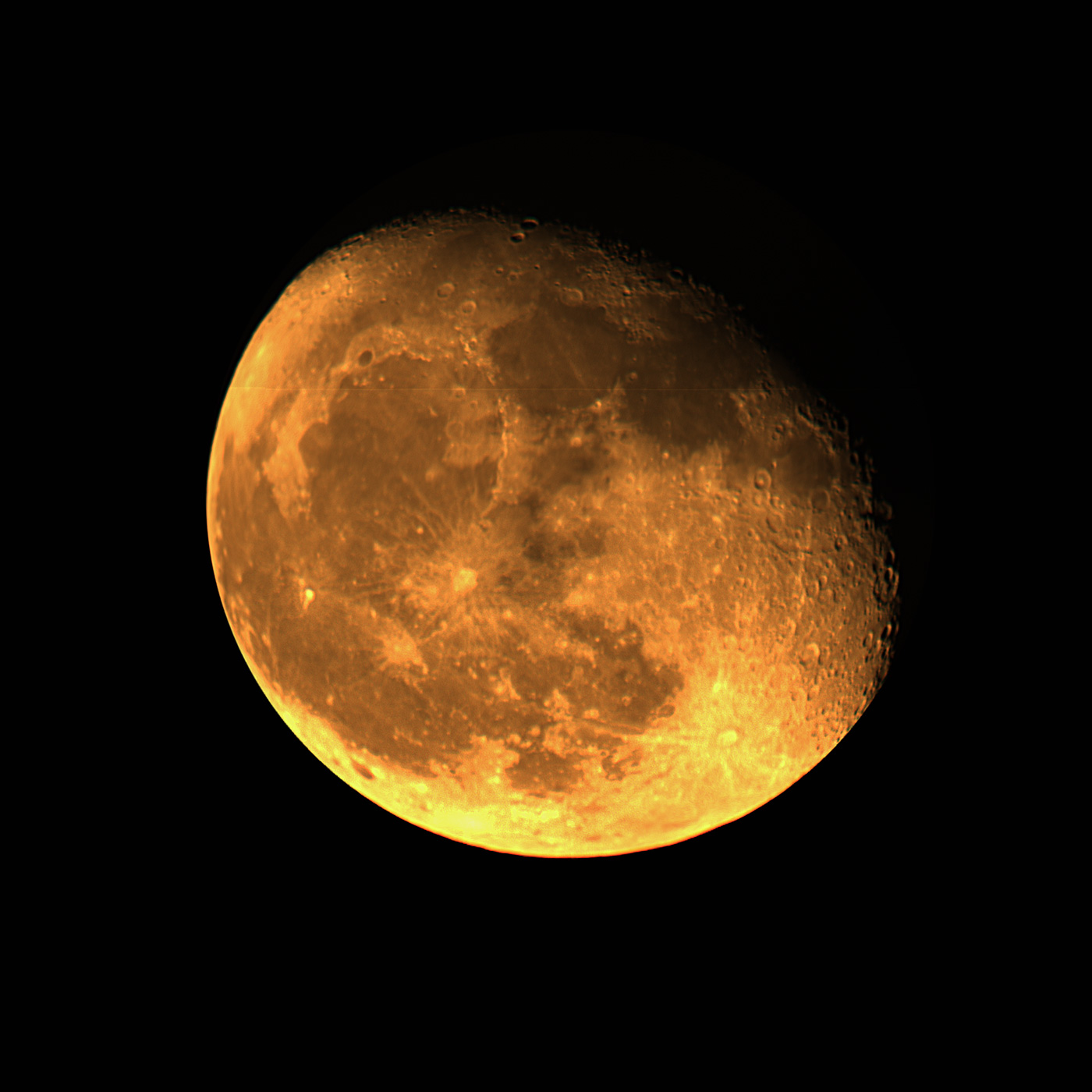
Exif
Camera: ZWO ASI585MC Pro.
Telescope: Altair Astro 70ED Telescope (420mm).
Mount: Sky-Watcher EQ5 Pro
Filter: UV/IR Cut
Guide Camera: ZWO ASI120mm-s
Guide Scope: SVBony 30mm (f4)
Computer: ZWO ASIAIR pro
Method:
Lights: 2 x 30 second videos.
Darks: 0
Flats: 0
Bias: 0
Stacked in Autostakkert individually, finishing touches and combining in Photoshop.
On 8th April this (Orion spaceship was some way out of frame, heading back from the Moon):
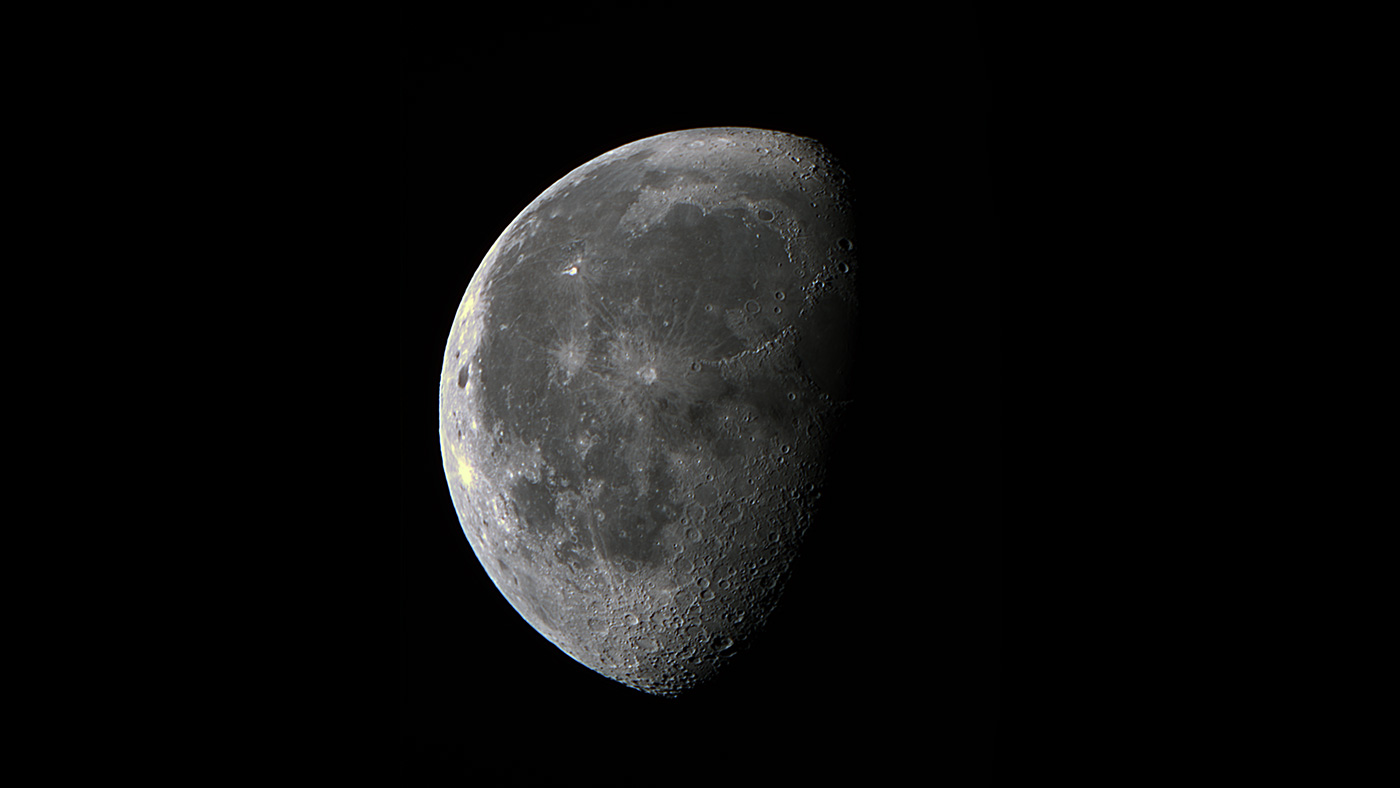
Exif
Camera: ZWO ASI585MC Pro.
Telescope: Altair Astro 70ED Telescope (420mm).
Mount: Sky-Watcher EQ5 Pro
Filter: UV/IR Cut
Guide Camera: ZWO ASI120mm-s
Guide Scope: SVBony 30mm (f4)
Computer: ZWO ASIAIR pro
Method:
Lights: 2 x 30 second videos.
Darks: 0
Flats: 0
Bias: 0
Stacked in Autostakkert individually, finishing touches and combining in Photoshop.
If you are interested in how I like to capture the moon and process the images, here is a guide.
Lunar
Visit Moon-phases website here.
Most annoyingly we are still in Galaxy Season where there isn't much around to image, other than Galaxies, and of course the Moon, and so I have taken a few more shots of the Moon. I just can't bare the thought of wasting a clear night!
Lyrids Meteor shower
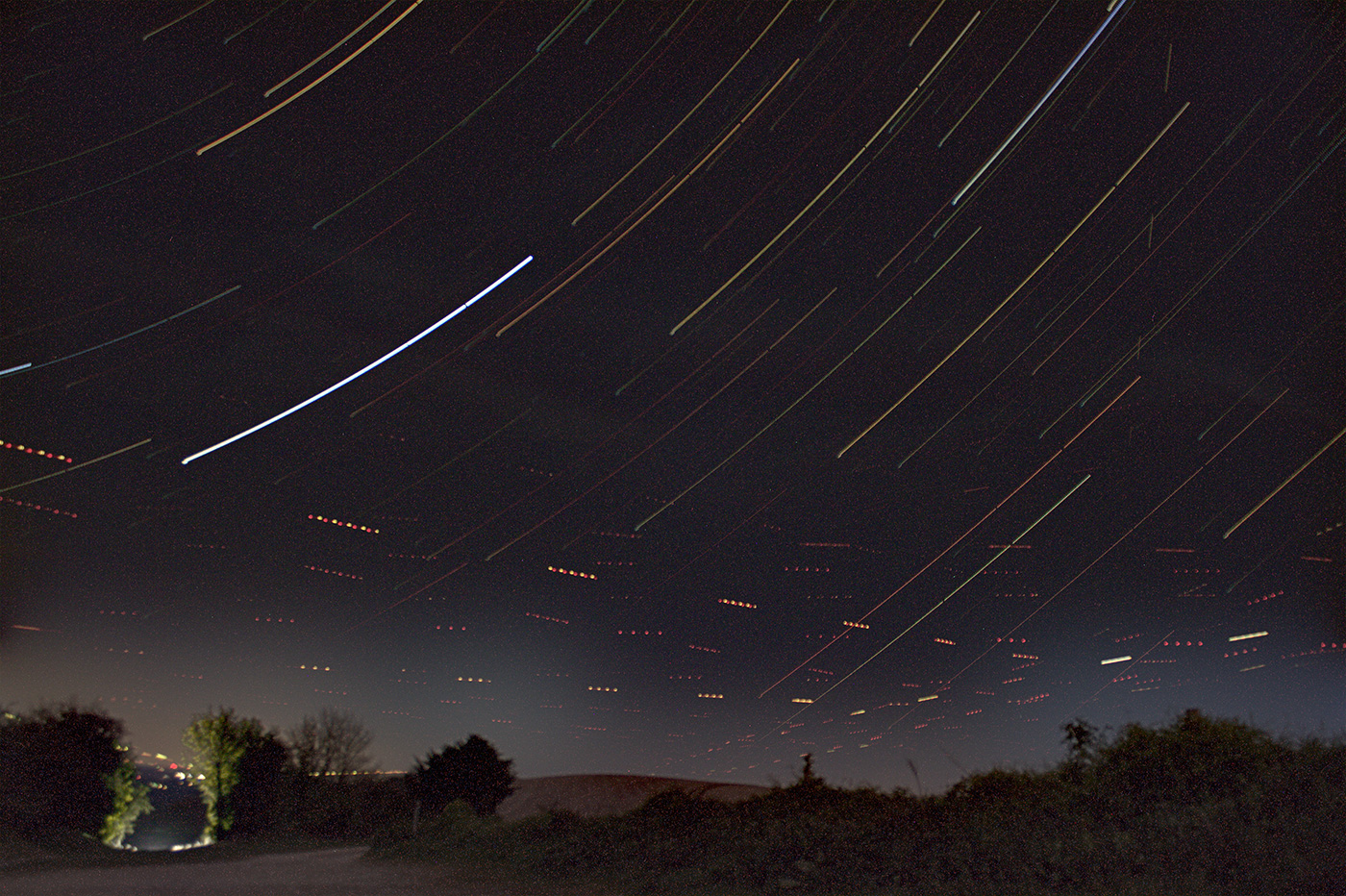
I don't often write about these, as our skies here in the UK are really too light polluted to be able to see any meaningful amount of Meteors and impossible with any sort of Moon in the sky and so I feel mentioning them will only lead to disappointment. So here is a star trails image that I took over 2 hrs from a 'Dark Sky' location. In person we saw precisely 2 meteors, I was hoping to capture them on camera, but as you can see I didn't! But what I did capture was a lot of aircraft!
What I do love about these images is that you can't hide your mistakes, if you take the brightest star in the image (Vega), you can clearly see where I accidentally kicked the tripod when I first started imaging, and the sub frames that I rejected because of car headlights etc. when I reviewed the images are clearly missing in the star trails. One car headlight was caught in the stack anyway and that is why you can see the trees illuminated in the lower left!
Of course I haven't exactly nailed this technique either, but I feel that the image does demonstrate the amount of varied colours stars have, and does inspire me to try again, and this time I may even focus the lens!
Exif
Camera: Canon 7D.
Lens: Canon EF-S 18-55mm @18mm.
Tripod: Manfrotto 190 Lite
Filter: None
Computer: Intervalometer (5 second exposure, 15 second pause)
Lights: 399 x 5 sec exposure (dropped 5 due to car headlights!).
Darks: 0
Flats: 0
Bias: 0
Stacked in Sequator.
The Sunflower Galaxy - M63
As you have read many times already in this blog, and also in my last blog, we are in Galaxy Season, the part of the year when our night sky orientation is pointing out away from our Galaxy where our local selection of Nebulae reside, and into intergalactic space! There are trillions of Galaxies out there, all different shapes and sizes and so it is interesting to image them, and in my case learn how to process those images, which I am sure you'll agree I am struggling to pull out the array of colours and hues that they have.
That flocculent pattern is what makes it stand out. Instead of the big sweeping arms you get in something like M51, M63 feels more like a living system, full of small knots and fragments that hint at constant activity.
It sits out in Canes Venatici at a distance where it is bright enough to be approachable but still far enough that you have to work for the detail. The core is compact and clean, and the surrounding arms form a loose halo of mottled light that stretches far wider than you expect on first inspection. There is a sense of depth to it, as if the structure is layered rather than flat.
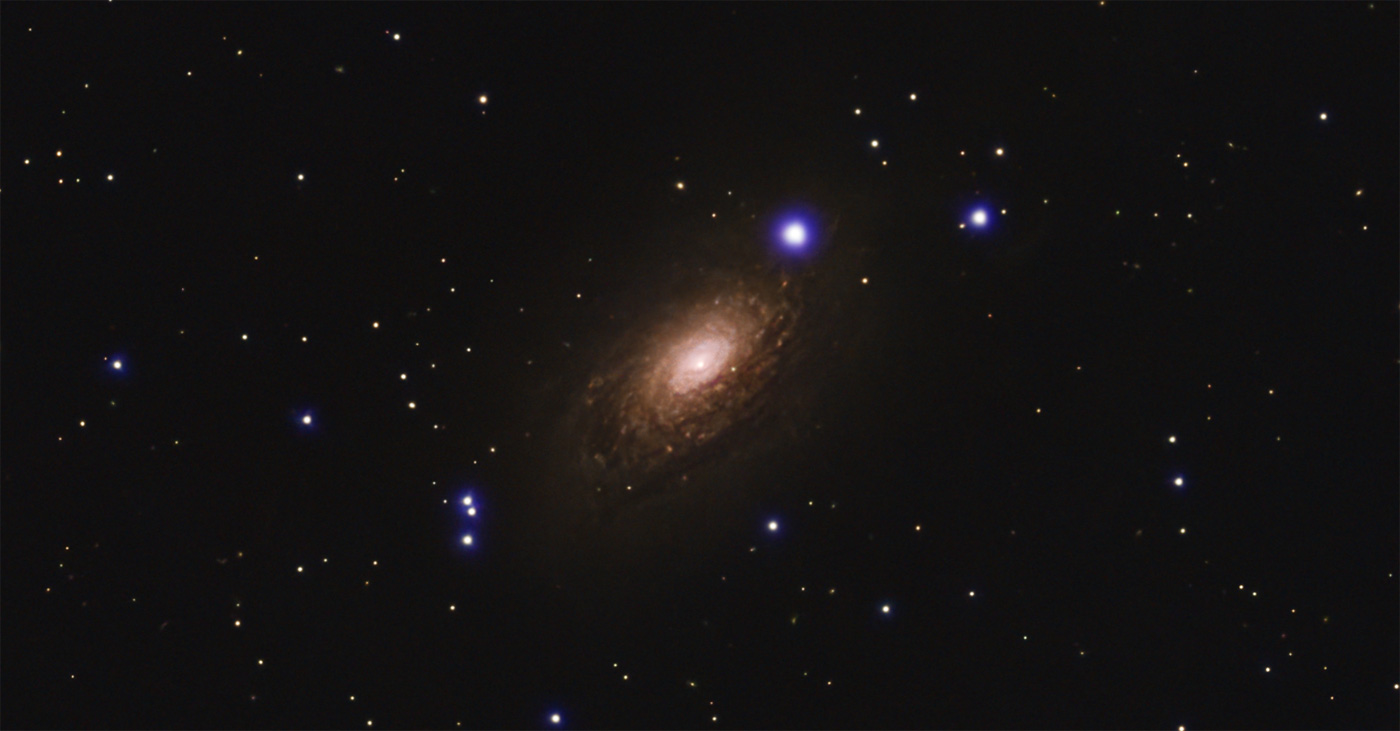
Exif
Camera: ZWO ASI585MC Pro.
Telescope: Altair Astro 70ED Telescope (420mm).
Mount: Sky-Watcher EQ5 Pro
Filter: UV/IR Cut
Guide Camera: ZWO ASI120mm-s
Guide Scope: SVBony 30mm (f4)
Computer: ZWO ASIAIR pro
Method:
Lights: 60 x 120 sec Gain 252.
Darks: 0
Flats: 0
Bias: 0
Stacked in DSS, Processed in Pixinsight with RC-Astro Suite of tools. Finishing touches in Photoshop.
The Pelican Nebula (IC 5070)
Those of you who read this blog regularly will know this wonderous nebula appears regularly, and for good reason. It is at this time of year when we start to see the hope of the Milkyway creep up into the very early morning sky. I could not resist to image this, perhaps a little too early as it was only about 17 degrees when I started, here is 4 hrs worth with the Optolong L eNhance filter. Next Month I shall hopefully have added to it another 4 hrs with the C2 filter to capture some SII which I can then combine all to make a SHO image.
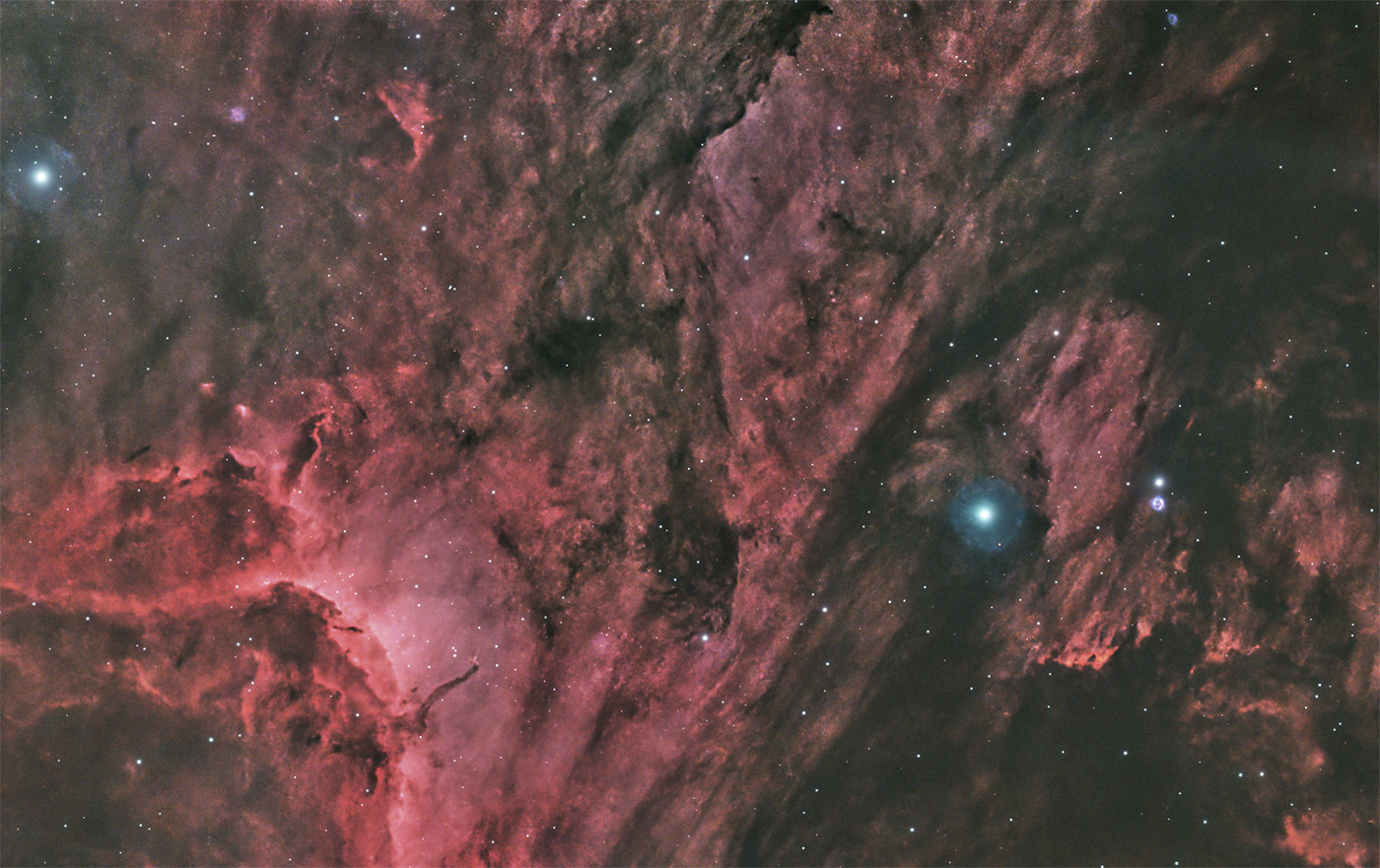
Exif
Camera: ZWO ASI585MC Pro.
Telescope: Altair Astro 70ED Telescope (420mm).
Mount: Sky-Watcher EQ5 Pro
Filter: Optolong L eNhance
Guide Camera: ZWO ASI120mm-s
Guide Scope: SVBony 30mm (f4)
Computer: ZWO ASIAIR pro
Method:
Lights: 120 x 120 sec Gain 251.
Darks: 0
Flats: 0
Bias: 0
Stacked in DSS, Processed in Pixinsight with RC-Astro Suite of tools.
The Tadpoles Nebula (IC 410)
The Tadpoles Nebula is one of those regions that immediately feels dynamic, as if you are looking at a snapshot of something mid‑transformation. It sits within the larger cloud known as IC 410, and its most recognisable features are the two elongated knots of gas and dust that stretch out like creatures swimming through space. These structures are dense enough to resist the intense radiation coming from the young stars nearby, so while the surrounding material gets pushed back and eroded, the heads of the tadpoles hold their shape and trail long, tapering tails behind them.
The whole region is tied to the young star cluster NGC 1893, which sits right in the middle of the nebula. The stars there are only a few million years old, and their energy is what sculpts the surrounding gas. You can see the effect clearly in the way the tadpoles point away from the cluster, shaped by the constant pressure of stellar winds. It is a reminder that star formation is not a gentle process. It is full of turbulence, compression, and erosion, all happening at once.
What makes the Tadpoles Nebula interesting to observe or image is the contrast between the bright, glowing gas and the darker, more solid structures of the tadpoles themselves. The nebula has a soft, diffuse glow, while the tadpoles stand out as sharper, more defined shapes cutting through it. With enough exposure time, the fine details in the tails begin to appear, showing how the material is being stretched and pulled apart over time.
The formal designation for the Tadpoles Nebula is IC 410, with the tadpole structures themselves catalogued separately as Simeis 129 and Simeis 130. Together they form a small but striking part of a much larger star‑forming complex, and they offer a clear view of how young stars can reshape the environment around them. It is a region full of motion and change, and that is exactly what makes it so compelling to study or capture.
Here I have split my imaging time between the C2 filter and L eNhance and then split the channels in Pixinsight, processed and then separately to generate an SHO image.
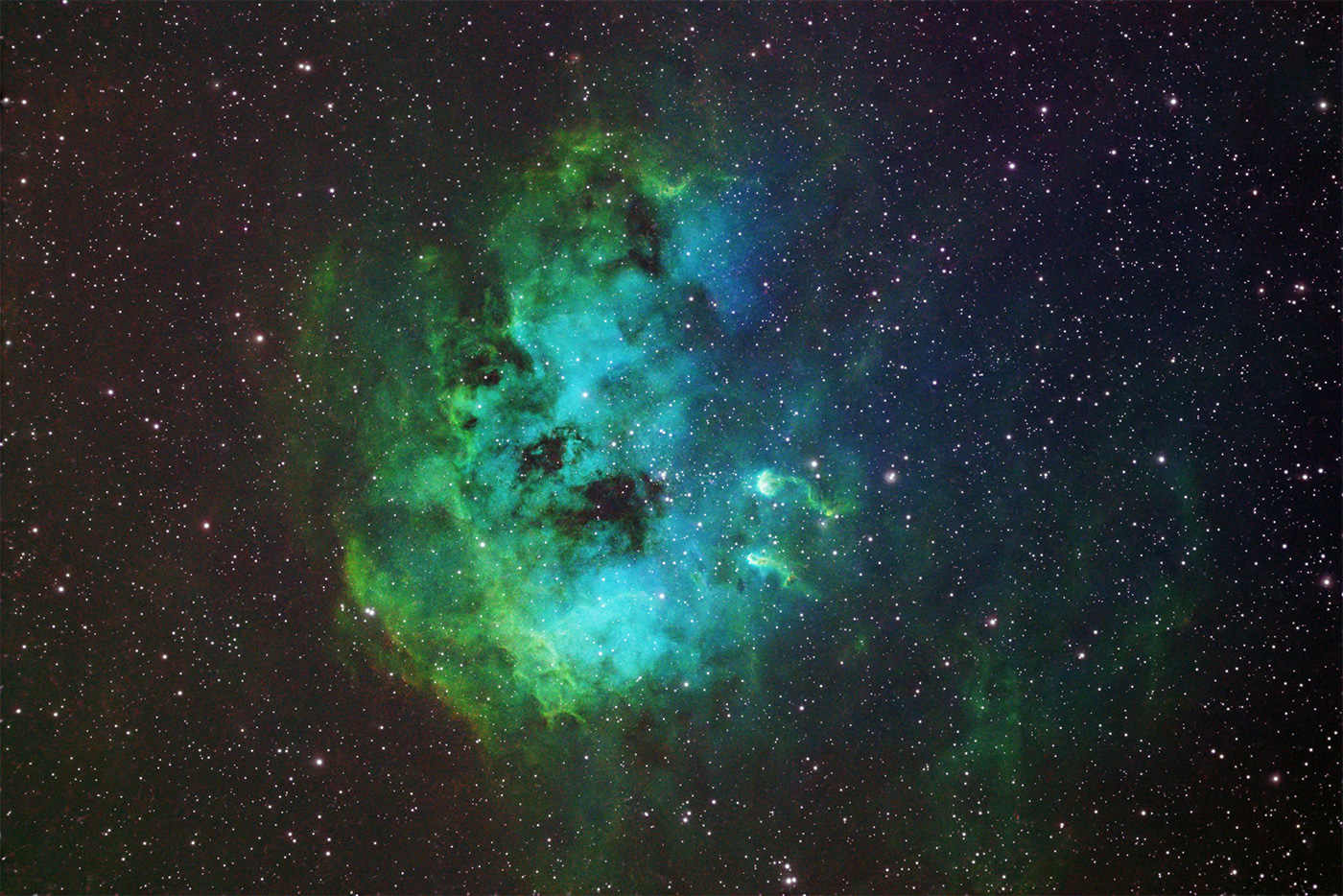
Exif
Camera: ZWO ASI585MC Pro.
Telescope: Altair Astro 70ED Telescope (420mm).
Mount: Sky-Watcher EQ5 Pro
Filter: Optolong L eNhance / Askar C2
Guide Camera: ZWO ASI120mm-s
Guide Scope: SVBony 30mm (f4)
Computer: ZWO ASIAIR pro
Method:
Lights: 30 x 120 sec Gain 251 with each filter.
Darks: 0
Flats: 0
Bias: 0
Stacked in DSS, Processed in Pixinsight with RC-Astro Suite of tools.
Share this post:
By Jonathan Penberthy on 28/04/2026

Jonathan Penberthy
Cosmic Shutter Seeker and Star Programmer
Jonathan Penberthy is the Cosmic Shutter Seeker and Star Programmer at Park Cameras, with over 20 years of experience as a software engineer. His career journey has spanned industries, but a move to Park Cameras sparked a passion for astrophotography. Jonathan’s interest began while working on a lens selection app, leading him to explore the night sky with a Canon 7D. When he’s not programming or photographing the stars, he enjoys sailing and navigating by the cosmos. Learn more on his profile page.
Trade in your old equipment
Fast and easy trade in service ensures your old gear is collected efficiently and you are paid quickly! It's very simple to trade in your unwanted photography gear. Just head over to our dedicated Sell or Part Exchange page, fill out the details, and we'll get back to you with an offer for your old gear. Take the cash, or put it towards the cost of your new gear. It's up to you! Find out more
sign up to the newsletter
Keep up to date on the latest photography news, events and offers. Sign up now